Whether you've noticed it or not, traditional cable TV viewership has been declining as cable companies have relentlessly raised prices without providing much new content (endless reruns of the same old shows). By some estimates, in 2023, traditional pay TV providers in the U.S. had lost 5.4 million subscribers, which was a significant increase from the 4.9 million who had proverbially "cut the cord" in 2022. At the same time, cable companies are trying to offset the losses by charging their remaining customers even more, which seems to be accelerating the trend.
Meanwhile, streaming options (paid, ad-supported or otherwise) including Google's YouTube TV, Disney's Hulu Plus Live TV, and services which skip the costly sports content such as Philo and Frndly TV, plus the rabbit-ear friendly OTA DVR system such as Tablo have all made it possible for more and more Americans to cut the proverbial cord with (at best) minimal disruption. Increasingly, mainstream consumers are dumping traditional cable TV services and streaming instead in order to slash their monthly bills. Although streaming costs have continued to rise, they remain less costly than traditional cable television services.
And, as previously hinted, there is now a growing plethora of so-called "FAST" (Free, Ad-Supported Streaming TV) services which offer an abundance of content people once turned to cable TV to watch which is available for no cost. Xumo Play now rivals Paramount's successful PlutoTV, having dedicated channels with Universal's content including such popular older shows including "Murder, She Wrote", "Little House on the Prairie", the cartoon "The Adventures of Rocky and Bullwinkle" and the "Bravo Vault" to name just a few. Now it includes Spectrum News+ as a unique offering which is not currently available on rival FAST streaming platforms at this time.
In some markets such as New York City, there are not only large cable TV providers such as Charter Communications' Spectrum cable service, but the legacy landline telephone service known as Verizon [branded Verizon FiOS in case the mobile business is separated from the legacy landline business] upgraded to fiber optic years ago, hence Verizon is a leading competitor to Spectrum. Still, the local cable company has offered its own 24/7/365 news service called NY1 (on cable channel #1, naturally, although in other markets such as Tampa, it is on channel 9 or on channel 13 in Central Florida) since 1992 in spite of periodic ownership changes for the cable company (Time-Warner sold its cable television business to Charter Communications in 2016). But NYC rival Verizon FiOS customers don't have access to NY1 local news, at least they didn't until 2024 when Spectrum's cable business reconsidered its local news strategy.
On July 15, 2024, Charter Communications officially announced (see https://corporate.charter.com/newsroom/spectrum-news-plus-launches-fast-channel-on-xumo-play for the announcement) that it was introducing the launch of a dedicated subchannel known Spectrum News+ on Xumo Play, which is the Free, Ad-supported, Streaming Television (FAST) service which operates as a joint venture of both Charter Communications and Comcast. Xumo also sells a streaming box known as the Xumo Stream Box which competes with Roku and Amazon's Fire Stick. Unlike those products, the remote control on the Xumo Stream Box has numbers so users can enter the channel numbers directly instead of being forced to scan thru every station.
At the moment, Comcast is still the owner of much of the NBC Universal content library, so Charter's contribution to the joint venture has been its acclaimed local cable news service. That said, Comcast officially announced a plan to spin-off its major cable networks, including USA Network, Syfy, MSNBC, and CNBC, into a separate, publicly traded company. Comcast is hardly alone. In 2022, rivals including AT&T did the same, followed by a similar move by Warner Bros. Discovery in an effort to rid themselves of their cable networks which had become slow-growth, marginally profitable businesses.
Still, if you were a New Yorker who had switched from Spectrum cable to Verizon because you got a better deal on basic television services, the new Verizon television service lacked NY1 so people simply did without it. That was until a free streaming alternative known as Spectrum News+ on Xumo Play had emerged. While Spectrum News+ combines news content from its local cable systems around the country (spanning selected markets in California, Florida, Hawaii, Kentucky, Maine, Massachusetts, Missouri, NYC as well as markets in upstate New York, in addition to markets in North Carolina, Ohio, Texas and Wisconsin), hence it's not identical to Spectrum's NY1 local news service. Instead, it is a more national cable news network with local coverage in the markets where Spectrum cable is offered.
As Charter noted in its original press release, the service is based in New York where NY1's newsroom operates, supplemented with original news content from other markets, including national weather as well as some award-winning local news content, such as "On Stage" https://ny1.com/nyc/all-boroughs/shows/on-stage which covers the NYC Broadway live-theater business (which now airs weekly on Spectrum News+ on Sunday evenings at 6:30 PM ET) and even live coverage of New York City's well-known Greenwich Village Halloween Parade.
Of course, corporate media outlets have done irreparable damage to their credibility, with a combination of an editorial decision to try and normalize an authoritarian political candidate who has promised to dismantle the fundamentals of democracy (including the free press) and poorly edited news content, but in response, news viewers have fled from those corporate-owned news outlets, which are now experiencing dramatic viewership declines because viewers now have more choices than ever for news. That's made local credible alternatives such as Spectrum News coverage appear far less biased and more objective than the major news networks. One issue is that so-called "corporate media" has for decades merged with and acquired one another to become giant corporate media outlets whose primary concern is about the bottom line, and less about objectivity in reporting or journalism as a profession, and viewers are now noticing.
Although Charter Communications could theoretically be considered a smaller member of "corporate media", until quite recently, it lacked a national platform for audiences, which limited its news coverage and access to that. With the advent of FAST streaming, suddenly Spectrum News has become a national player in news delivery. Perhaps it is appropriate to see where this goes in the future given how corporate media has notably been failing the American public in recent years.
My readers may recall that I previously blogged about the now-defunct retailer Kmart and how the Internet Archive has recordings of the in-store entertainment which ran for shoppers when those stores still existed. Catch my coverage at https://hgm.sstrumello.com/2018/12/strange-archives-attention-k-mart.html for more. As we approach the 2024 holiday season, some people may find that a walk down memory lane!
However, in late September 2024, the U.S. news was filled with different stories about how the once-ubiquitous discount retailer Kmart was officially closing the company's last remaining store still operating in the United States. The Associated Press article found at https://apnews.com/article/kmart-closing-sears-blue-light-last-store-6b302bbaec8c003351f62aefcf0528b4 was as good as any of those covering that particular news.
Photo credit: Laura Oliverio/CNN
Reportedly, the last full-sized Kmart store still operating in the U.S. was located in Bridgehampton, NY (located on Eastern Long Island, which is located in the area referred to as "the Hamptons"), which is also an area which is perhaps best known for its having multimillion dollar mansions for the rich and famous and also being just steps away from some of the best beaches in the Northeastern United States. The store itself had opened in 1999, so it was not really a long-standing store location. However, evidently, for basic necessities like trash bags, bath towels or light bulbs, there were few other places out in the Hamptons where people could actually buy those things at fair prices, hence the Bridgehampton Kmart store managed to survive even after hundreds of other Kmart locations had closed around the country).
The October 20, 2024 news reported that the quiet closing date for the Bridgehampton, NY Kmart store had been discovered when the press called that store location, and the closure date was according to an employee who answered the phone at the Kmart store (she did not want to give her name). The manager of the last remaining Kmart store was not available, but the corporate owner was an entity known as Transformco, the company that bought the remains of the old Sears and Kmart out of the bankruptcy of what was known as Sears Holdings back in 2019, and the owner did not return an email from the Associated Press requesting comment.
That Kmart store closure will reportedly leave just one much smaller Kmart store located in Miami, Florida although there are still also a handful of Kmart stores located on the islands of Guam and on the U.S. Virgin Islands. Back in its heyday, there were more than 2,000 Kmart store locations in the U.S. (or even more if you include the locations of the former mall anchor known as Sears (which also happened to be another formerly-giant U.S. retailer earlier in the twentieth century; back in the day, Americans even bought home plans from Sears and some of those homes are still standing). The two chains were combined in an odd marriage of convenience a number of years ago thanks to a vulturous private equity investor.
As noted, the 2009 Sears-Kmart combination was always odd, but it was orchestrated by a hedge fund multibillionaire named Edward (Eddie) Scott Lampert who ran the hedge fund (which was largely Lampert's own money) known as ESL Investments; the name was derived from Mr. Lampert's initials. In 2003, ESL Investments took control of a then-bankrupt Kmart and merged it with another failing retailer known as Sears two years later in an $11 billion deal that eventually sank both retailers. An excellent overview of Mr. Lampert's "predatory capitalism" was chronicled by the publication known as Institutional Investor in an article entitled "Eddie Lampert Shattered Sears, Sullied His Reputation, and Lost Billions of Dollars. Or Did He?" (see the article at https://www.institutionalinvestor.com/article/2bsxn8l0u5yr6zhelmhog/corner-office/eddie-lampert-shattered-sears-sullied-his-reputation-and-lost-billions-of-dollars-or-did-he for the entire article).
Eddie Lampert. Photo credit: Vincent Laforet/The New York Times
Mr, Lampert truly earned the pejorative nickname "fast Eddie" and "vulture capitalist" for an excellent reason.
Under his ownership, ESL swapped an estimated $2.6 billion in Sears debt with secured debt, bringing the total to nearly $3 billion. Most of those debts which he transferred to the Sears balance sheet were from ESL's books. In other words, he had loaded a struggling retailer up with debts which were never created by Sears or Kmart in the first place. That was little more than a convenient and legal way for a private equity firm to eliminate many of its own debts derived from failing companies which ESL had acquired by loading one of the acquired companies up with their debts, and ESL would simply not bother repaying those bonds, screwing bondholders in the process, all while Eddie Lampert eliminated some of his company's debts. In other words, Sears-Kmart was viewed as a disposable entity serving only the needs of Eddie Lampert's ESL Investments to get rid of some debts it actually owed.
Regardless of the idea of disposing of two old retailers in order to enrich himself, the loss of these stores left many big mall operators around the country, such as the Simon Property Group, with hundreds of big vacancies nationwide and few apparent replacement retailers who are able to fill those now-vacant stores. That's forced a number of mall locations to become more creative by repurposing and leasing the vacant old Sears stores to other retailers like Target or Costco which is a straightforward leasing arrangement. However, others have been converted into movie theaters (except many movie theater chains are in no position to expand given their own weak balance sheets). Still, others have been forced to convert those store locations into things like affordable apartments instead. The latter has grown to become quite a popular option, and it does solve two issues: the vacancy problem for the malls themselves, and also more affordable housing.
For its part, Kmart was once one of America’s leading discount retailers, but has now closed its final, full-size store in the mainland United States. The Sears and Kmart retail operations were eviscerated a number of years ago. Mr. Lampert knew nothing about the retail business in the first place, but as noted, the closure of two large retailers left shopping centers including enclosed malls and strip malls alike across the country vacant.
While Kmart and Sears may be vestiges of the nation's retailing past, the bigger issue in my assessment is the debt swap orchestrated by private equity investors. If lawmakers want to do something meaningful, disabling private equity firms ability to transfer debts incurred to other companies they own should arguably not be permitted. For private equity owners, it represents a shrewd way of eliminating debt as if it were a mere accounting gimmick. But in reality, that gimmick screws bondholders out of money they should and would otherwise be entitled to collect from the company which the private equity firm owns. Perhaps leaving a retailer for dead to write-off debts from bad investments is not a good policy?
From left: Matt Bomer, Nathan Lane, Nathan Lee Graham and Linda Lavin in 'Mid-Century Modern' Photo: Disney/Chris Haston
Short Version:
A Potential "The Golden Girls" Successor: "Mid-Century Modern" (which arguably could be called "The Golden Gays") in production for Hulu
Similarities to "The Golden Girls"
Premise: Both shows feature older housemates sharing their lives. "Mid-Century Modern" has three older gay men and one of their mothers living together in Palm Springs, while "The Golden Girls" had four older widowed women (including a mother and her daughter age 55+) in Miami.
Characters: Nathan Lane will play the character seemingly the most similar to "Dorothy Zbornack" on "The Golden Girls"; although he will be the homeowner (more like the character "Blanche Devereaux" on "The Golden Girls") named Bunny Schneiderman who lives with his mother in Palm Springs. Also, like "Sophia Petrillo" in "The Golden Girls," Sybil Schneiderman (played by Linda Lavin) is the mother figure in "Mid-Century Modern." Matt Bomer's character Jerry Frank might fill a similar role to the naïve "Rose Nylund", but the other character appears less directly comparable at this time.
The Cast and Creative Team
The series stars Nathan Lane, Matt Bomer, Nathan Lee Graham, and Linda Lavin.
It's created by Max Mutchnick and David Kohan (perhaps best known for "Will & Grace") and executive produced by them along with Ryan Murphy and James Burrows.
20th Television is the studio behind the show.
The Premise
After a friend's unexpected death, three gay men "of a certain age" decide to live together in Palm Springs, along with one of the character's mother.
The wealthiest of the men (played by Nathan Lane) is the homeowner Bunny Schneiderman who happens to live with his mother Sybil (played by Linda Lavin) in Palm Springs.
Matt Bomer portrays a character named Jerry Frank who is somewhat similar to Betty White's ditsy Rose Nylund from "The Golden Girls." Variety reported "Jerry left the Mormon Church and his marriage in his early 20s after his wife informed him and the rest of the congregation that he was a homosexual. Now a latter-day saint in the literal sense of the term, Jerry is pure of heart. He is also hard of body and soft of head."
Perhaps the least developed character, Arthur Broussard (played by Nathan Lee Graham), will have his backstory fleshed out by the writers.
Production Status
Hulu has ordered a full season of the show.
Filming for the pilot episode has been completed.
"Mid-Century Modern" is set to release in 2025, and since it's on a streaming platform (Hulu), it's likely only going to have 10 episodes in its first season.
Context
"The Golden Girls" was a groundbreaking sitcom featuring older women. "Mid-Century Modern" has the potential to be similar for a gay audience.
Streaming services like Hulu offer more freedom in terms of content compared to network television.
Open Questions
The show's premiere date is yet to be announced. [See the Author P.S. below, which acknowledges "10 episodes of the show are set to drop on Hulu on March 28, 2025"].
The role of the "naked Gen Z housekeeper" named for the show has not been identified.
Overall, "Mid-Century Modern" appears to be a promising new sitcom with a talented cast and experienced production team. Whether it captures the magic of "The Golden Girls" remains to be seen, but it certainly has the potential to be a success on Hulu.
"The series follows three best friends — gay gentlemen of a certain age — who, after an unexpected death, decide to spend their golden years living together in Palm Springs where the wealthiest one lives with his mother. As a chosen family, they prove that no matter how hard things get, there's always someone around to remind you it would be better if you got your neck done."
When Variety first reported (see https://variety.com/2024/tv/columns/matt-bomer-nathan-lane-golden-girls-ryan-murphy-1236041246/ for details) that the streaming TV network Hulu had ordered a pilot episode of "Mid-Century Modern" produced as a multi-camera sitcom series to be executive produced by Ryan Murphy and "Will & Grace" creators Max Mutchnick and David Kohan via their KoMut Entertainment business, there were instant comparisons made between the new show and an earlier sitcom known as "The Golden Girls". Like many people, when I heard that a pilot was ordered, I was both hopeful (if somewhat skeptical) because we've been teased with similar efforts over the years, and for one reason or another, none ever came to fruition.
Two months after reporting that the cast for a pilot had been identified, Variety subsequently reported (see https://variety.com/2024/tv/news/hulu-comedy-mid-century-modern-nathan-lane-matt-bomer-nathan-lee-graham-linda-lavin-1236105352/ for the article) that Hulu had ordered a full-season of "Mid-Century Modern", and actress Linda Lavin (perhaps best remembered as the star of the seventies sitcom "Alice") had shared some photos on social media that the actors had just finished recording the pilot episode of the show.
"Hulu has given a series order to the comedy 'Mid-Century Modern,' Variety has learned." In other words, the streaming platform had ordered a full season of the proposed sitcom. Variety also reported "The series was created by Max Mutchnick and David Kohan, with both also executive producing. [Nathan] Lane and [Matt] Bomer are also executive producers, along with Ryan Murphy and James Burrows, with Burrows having directed the pilot. 20th Television is the studio."
Short Back Story of the Predecessor "The Golden Girls"
"The Golden Girls" was a TV sitcom created by Susan Harris and ran on the NBC broadcast television network from 1985 to 1992. That show became one of the most beloved sitcoms of all time, chronicling the story of four widowed, aging women who share a house together in Miami. Looking back, it's helpful to understand how "The Golden Girls" came to fruition. On August 24, 1984, two actresses "of a certain age," each then acting on a hit NBC show (Selma Diamond was a regular on NBC's Thursday night sitcom from the eighties known as "Night Court", while Doris Roberts was on NBC's "Remington Steele" at the time), stepped onstage at the network's Burbank headquarters as presenters at the NBC's fall preview special.
The two actresses traded scripted patter from a teleprompter, and in the process, they also did more than a little ogling of the [new] male leads in one of the peacock network's more promising new dramas of that era: "Miami Vice". But the way those two actresses delivered that dialogue proved to be quite entertaining. The object of their affection? None other than Don Johnson, who was about to debut in the fashion- and decade-defining hit "Miami Vice". And the gawking [older] gals, whose performance that night inspired then-NBC president Brandon Tartikoff to commission a sitcom about the active lives (and loves) of the over-sixty set.
Below is a clip of that Selma Diamond and Doris Roberts interaction from that 1984 NBC fall preview (or at https://youtu.be/b0RSJpV-ZE4?si=UVtyTU11vAP7HD2C if you are reading from a mobile device) which some believe was the place where the idea for "The Golden Girls" actually emerged.
The cast of "The Golden Girls" included Bea Arthur (who played the sarcastic Dorothy Zbornack), Rue McClanahan (who played the sexy Southern belle Blanche Devereaux), Estelle Getty (who played Dorothy Zbornack's wisecracking but also wise mother Sophia Petrillo), and Betty White (who played the ditsy Rose Nylund), and the show remains an often-quoted and rewatched series even today in spite of the last episode having aired more than 30 years ago (as of 1992).
"The Golden Girls" was an unlikely hit — and kind of a lucky accident. Originally proposed as a joke at NBC, it only came to life thanks to a network executive who realized the concept was so crazy that it just might work; and a groundbreaking, boundary-pushing producer helped bring it to life. On paper, the concept seemed like it could never attract a mainstream audience: four ladies of advanced age, sharing a house in Miami and lusting after men. But the concept of older women, which aired on Saturday evenings, became a top hit, and part of NBC's "Must See TV" lineup during that era. And it starred legendary TV sitcom veterans (Estelle Getty being the notable exception having extensive stage experience, but marginal TV experience) to boot, which helped to cement the show's iconic status.
Success for "The Golden Girls"
In fact, during its original run, "The Golden Girls" was nominated for a total of 58 Primetime Emmy awards, winning eleven including the award for Outstanding Comedy Series in 1986 and 1987. Also, all four principal stars of "The Golden Girls" won an Emmy Award for their performances, which is an accomplishment relatively few sitcoms have since replicated. All around, "The Golden Girls" show quickly became a sitcom hit, which ran for a now-unfathomable seven seasons and won numerous awards during its seven-season run.
The very notion of older women spending their retirement years together with a "chosen family" also resonated strongly with gay and lesbian audiences, who were often forced to live with chosen families by necessity because some of their own families had disowned them for being gay. Ironically, "The Golden Girls" was also uncharacteristically gay-tolerant on broadcast television during a period of time when the AIDS epidemic was happening, while an indifferent Reagan administration in office sat by and did little other than to help foster general societal homophobic attitudes in its thinly-veiled efforts to try and cement votes by pandering to socially conservative voters.
While the team bringing "Mid-Century Modern" to TV today might dispute the notion of their show being simply a modern reboot of "The Golden Girls", the press certainly has been willing to suggest that it has potential to be just that. Perhaps it's best to leave the conclusion to you once "Mid-Century Modern" premiers.
Following The Rule of Four
Many of Hollywood's most enduring movies and TV shows tend to consist of four primary lead characters. Perhaps that's because it allows writers to explore four unique character archetypes and how they play-off one another in a group dynamic. Regardless, groups of four main characters in entertainment have, over time, made for some of the most memorable entertainment teams of all time. For example:
In the 1939 movie "The Wizard of Oz", a foursome consisting of the characters Dorothy (Judy Garland), the Scarecrow (Ray Bolger), the Tin Man (Jack Haley), and the Cowardly Lion (Bert Lahr) helped drive that movie into longevity
On television, not only did we have four central characters on "The Golden Girls" during the eighties, but we had earlier precedent with such legendary sitcoms with cast foursomes in the smash fifties TV sitcom "I Love Lucy" which was focused primarily on Lucy Ricardo (Lucille Ball), Ricky Ricardo (Desi Arnaz), Ethel Mertz (Vivan Vance) and Fred Mertz (William Frawley)
That dynamic was later replicated with such shows as "Seinfeld" with Cosmo Kramer (Michael Richards), George Castanza (Jason Alexander), Elaine Benes (Julia Louis-Dreyfus), and of course Jerry Seinfeld (played by Jerry Seinfeld) as its four main characters.
More recently, we've had shows with four main characters, such as on "Sex and the City" with the characters of Carrie Bradshaw (Sarah Jessica Parker), Samantha Jones (Kim Cattrall), Miranda Hobbes (Cynthia Nixon), and Charlotte York (Kristin Davis)
On the long-running Chuck Lorre-produced sitcom "Big Bang Theory", which had Sheldon Cooper (Jim Parsons), Leonard Hofstadter (Johnny Galecki), Howard Wolowitz (Simon Helberg) and Raj Koothrappali (Kunal Nayyar) and featured four central characters.
There are, of course, other examples, but those are some prominent ones which come to mind.
"Mid-Century Modern" Could Become a 21st Century Version of "The Golden Girls" (or maybe more accurately, "The Golden Gays")
Nathan Lane: The homeowner Bunny Schneiderman who lives with his mother Sybill in Palm Springs. Bunny is a successful businessman with one foot in retirement, and is forever in search of love, but he first has to be convinced he's worthy of it.
Linda Lavin as elder Sybil Schneiderman. Like her son, Sybil's strengths are her weaknesses: wise, caring, and iconoclastic – which sometimes means she's critical, smothering and amoral.
Matt Bomer: Jerry Frank, an ex-Mormon who was outed to his entire Congregation by his ex-wife, he's "hard of body" and "soft of head"
Nathan Lee Graham: Arthur Broussard, a dignified, elegant, longtime member of the fashion industry who believes that life will never quite match the grace and panache that would exist if only he were in charge. This description sounds like it could be incredibly funny. The actor's prior TV roles consisted of a host of episodic roles (including on such comedies as "Absolutely Fabulous"), as well as being a regular on the sitcom "LA to Vegas" in which he played Bernard Jasser, a flamboyant male flight attendant.
Of note is the fact that on the original sitcom "The Golden Girls", actress Rue McClanahan was only age 51 in 1986 when "The Golden Girls" began (just five years older than Matt Bomer is in 2024), while Betty White was age 63, Bea Arthur was also age 63, and Estelle Getty was age 62. By comparison, Matt Bomer is age 47, Nathan Lee Graham is age 55, Nathan Lane is age 68, while Linda Lavin is 86 in 2024.
Deadline Hollywood described the situation this way (see HERE):
The very quick decision-making — especially by Disney standards — is not that surprising. In addition to an A-list creative team in front and behind the camera, the pilot has been enjoying a very strong word- of-mouth internally that kicked into high gear after the table read.
Cast's Previous Relevant Work for "Mid-Century Modern"
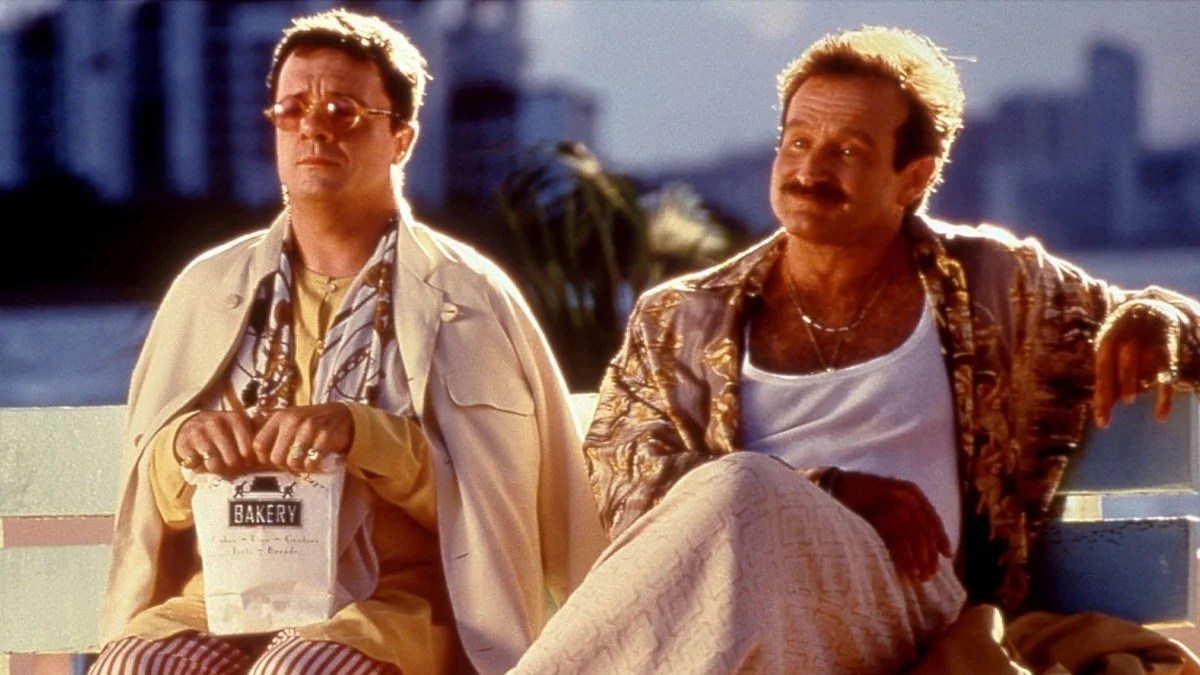
As for casting of "Mid-Century Modern", already acknowledged was Nathan Lane, whose big-screen portrayal of the gay character Albert Goldman in the 1996 big screen movie "The Birdcage" (which was the American movie adaptation of the 1978 hit French film "La Cage aux Folles"). In that movie, Nathan Lane played the life-long same-gender partner of the Robin Williams character Armand Goldman and also as the drag queen Starina in their drag club known as "The Birdcage". That alone suggests Nathan Lane will be well-suited for his new role as Bunny Schneiderman. His prior role as Albert Goldman proves his well-practiced comedic timing. Again, Variety described Nathan Lane's character in "Mid-Century Modern" as "a successful businessman named Bunny Schneiderman who's forever in search of love but needs to be convinced he's worthy of it."
Nathan Lane (left) and Robin Williams (right) in "The Birdcage". (Credit: MGM/UA)
Nathan Lane will co-star with Matt Bomer, as well as Nathan Lee Graham (all three openly gay actors in real-life) and Linda Lavin on "Mid-Century Modern". The fourth character played by Linda Lavin, aside from being a Tony and Golden Globe award winner herself, she was also nominated for a number of Emmys for her TV role as Alice Hyatt on the TV sitcom "Alice" which ran for a total of nine seasons between 1976 and 1985. There is no denial that Linda Lavin is a sitcom veteran.
Ms. Lavin will step into the role of Sybil Schneiderman on "Mid-Century Modern" as the Nathan Lane character Bunny Schneiderman's mother who lives with her son in Palm Springs. On the sitcom "The Golden Girls", Estelle Getty played the comparable role of Sophia Petrillo. Linda Lavin brings a wealth of acting experience to the role, not only for her portrayal of Alice Hyatt on the long-running TV sitcom "Alice", but also having more recently starred in such short-lived TV sitcoms such as "9JKL" and "B Positive."
Matt Bomer will play the character perhaps most akin to Betty White's ditsy character Rose Nylund on "The Golden Girls" and he will be known as Jerry Frank on the new series. The character of Jerry is described as "pure of heart, hard of body and soft of head." The show notes also describe Jerry as a former Mormon who left his marriage in his 20s after his wife told him and the rest of their congregation that Jerry was gay. Bomer previously starred in the TV drama "White Collar" as a con-man and forger on that show.
In what appears to be the least fully-developed character on "Mid-Century Modern" is the character of Arthur Broussard, who will be played by actor Nathan Lee Graham. So far, there has been considerably less back-story released about the character of Arthur when "Mid-Century Modern" actually premiers, although the show's writers will be able to fill in those blanks for viewers. What we do know about Arthur is described in the show notes as "a dignified, elegant, longtime member of the fashion industry who believes that life will never quite match the grace and panache that would exist if only he were in charge".
First, he confirmed that Season 1 will consist of 10 episodes (much like many streaming sitcoms have).
Beyond that, he told Mr. Musto:
"The show ['Mid-Century Modern'] is its own thing, but it's nice to be compared to something you truly love ['The Golden Girls']."
When asked who is the show's Dorothy Zbornack (Bea Arthur's character on "The Golden Girls"), Graham response was telling:
"Here's the thing. We’re all combinations of all of them, of different sorts. But I’d say that Arthur is mostly a Dorothy." He added: "...also, we all have those wonderful quips and sneers and deadpan looks [most similar to the character Dorothy Zbornack on "The Golden Girls"]."
He added:
"I love the little connections [to the characters in "The Golden Girls"]. As for Blanche, there's a little of her in all of us, but some other cast members are more Blanche than I."
That suggests while there will be similarities, it will not simply be a modern reboot of a loved, old show. It will be its own show with characteristics in each character from those loved in "The Golden Girls".
Life After "Will & Grace" on TV
The TV sitcom "Will & Grace" was one of the most successful television series with gay principal characters and aired between 1998 to 2006 (which returned for a single season in 2017). Max Mutchnick and David Kohan created "Will & Grace" which focused on the friendship between best friends Will Truman (Eric McCormack), a gay lawyer, and Grace Adler (Debra Messing), a straight interior designer. Alongside them were their friends Karen Walker (Megan Mullally), a demonically alcoholic socialite, and Jack McFarland (Sean Hayes), a gay neighbor and sometimes actor. Those four cast members were the core cast of "Will & Grace", which was the most successful television series with gay principal characters. "Will & Grace" ran for eight seasons, although as noted, the show was brought back on television with a ninth season which aired during 2017–2018.
In 2012, during an appearance on NBC's "Meet the Press," then Vice President Joe Biden said "I think 'Will and Grace' probably did more to educate the American public [about what gay individuals are actually like] than almost anything anybody's ever done so far."
In more recent years, we have enjoyed some ground-breaking TV sitcoms (many on paid streaming platforms) with openly gay characters, including the original Netflix series "Grace & Frankie" which was about two senior women whose husbands leave them (for men, specifically each other's husbands). That Marta Kauffman-created series co-starred the legendary Lily Tomlin (herself a lesbian) and Jane Fonda, along with their recently-out gay ex-husbands on the show played by Martin Sheen and Sam Waterson. Tomlin and Fonda are perhaps best remembered for their blockbuster eighties feminist comedy movie "Nine to Five". In "Grace & Frankie", the two actresses ended up creating comedic gold aimed squarely at an older, and decidedly gay-friendly audience.
But all good things must eventually end, and "Grace & Frankie" enjoyed an impressive seven season run in the modern media environment, becoming the longest-running original series on Netflix. Now, "Grace & Frankie" now enjoys a dedicated subchannel on free ad-supported streaming TV apps including on the Roku Channel and on Plex, where the un-edited show now streams continuously on a loop (and it's available for no subscription charge!).
Still, "Grace & Frankie" was about two older, heterosexual women living together (their ex-husbands were gay, and were recurring characters on the show, although those characters were more about setting the show's basic premise of older women learning to live life after their husbands leave them for each other's husband, rather than the show being specifically about the gay couple specifically.
That's why "Mid-Century Modern" reads as something of a gender-swapped interpretation of "The Golden Girls" with a slight twist in that the character of Sybill Schneiderman is also a mother like Estelle Getty's character on "The Golden Girls" known as "Sophia Petrillo" was, and the mother character on "Mid-Century Modern" will be played by Linda Lavin. But, aside from "Grace & Frankie", we haven't really had much on television which had both the older-age angle, along with a particular gay sensibility. Really, "The Golden Girls" set a modern gold standard which so far, has proven quite hard to replicate with such a legendary cast and consistently exquisite writing and producing.
Certainly the cast, and the creative and production talent behind "Mid-Century Modern" all suggests this show is likely to be successful. Officially, there is no word yet on when the show expects to be introduced.
In other words, the new show looks somewhat like a modern-day reboot of "The Golden Girls" featuring three gay men, along with one of the character's mother, all sharing a house together. "Mid-Century Modern" also reportedly will feature a "naked Gen Z housekeeper" although it's unclear how central to the storyline that will actually be. And while "The Golden Girls" was set in Miami, Florida, "Mid-Century Modern" will be set in Palm Springs, California, those differences are rather minor. Of course, Hulu is not restricted by the federal law which "prohibits obscene, indecent and profane content from being broadcast on the radio or TV" because streaming shows are not governed by the FCC, it is a genuine sitcom with legitimate names and talent behind it, so no one expects it to be filth.
Nevertheless, the similarities between the two shows ("The Golden Girls" and "Mid-Century Modern") are not hard to notice. For example, one of the characters happens to live with his mother, while two other roommates live with them in the same house. They are all slightly older (although some critics have noted that Matt Bomer is currently age 46, he will likely play a character who is likely age fifty, and it's worth remembering that actress Rue McClanahan was age 51 in 1986 when "The Golden Girls" first began (5 years older than Matt Bomer is in 2024).
"Mid-Century Modern" Production Nuts and Bolts
Kohan and Mutchnick formed company with a name combined from their two last names known as KoMut Entertainment, which helped make such TV shows as "Boston Common", "Will & Grace", "$#*! My Dad Says" and "Partners". In addition to several movies, Ryan Murphy created the FX cable TV drama series "Nip/Tuck", then produced a musical comedy-drama musical series known as "Glee" which ran on Fox for 6 seasons, followed by the anthology series "American Horror Story" which ran on FX for 12 seasons.
But now that the "Mid-Century Modern" series has the go-ahead, it means they just need scripts, then they can record the episodes.
The basic premise of the "Mid-Century Modern" series will be that it follows three best friends — gay gentlemen "of a certain age" — who, after an unexpected death, decide to spend their golden years living together in Palm Springs where the wealthiest one (played by Nathan Lane) lives with his mother (played by Linda Lavin). A less developed fourth character Arthur will be played by Nathan Lee Graham; the fourth character on "The Golden Girls" was Blanche Devereaux (played by Rue McClanahan) who was a sexy Southern belle. We'll wait for the writers to fill-in Arthur's backstory and what his character will be like, but remember: "Mid-Century Modern" will not be exactly like a "Golden Girls" reboot, so we may see certain behaviors exhibited by different characters.
"Mid-Century Modern" will run on the streaming platform Hulu, which is owned by Disney, although Hulu has struggled somewhat to gain a loyal following, lacking any "must-see" comedy sitcoms other than old reruns of old TV shows (including the original version of "The Golden Girls"). Streamers do seem to have considerably more leeway in terms of story lines which network TV has to edit out to avoid FCC charging them with obscenity. Streamers also don't necessarily need to stick to a particular amount of time for a given episode, although most do for consistency and for the benefit of their writers and actors. However, language need not be sanitized unnaturally. Ditto for occasional nudity, although it's not porn. The new series will be set in Palm Springs, California which is known for being home to a large LGBT population. The show already has a core cast, a director, writers, producers, etc. James Burrows is directing the pilot. Max Mutchnick, David Kohan, Burrows, Lane and Bomer will also exec produce. 20th Television is the studio. "Mid-Century Modern" is set to release sometime in 2025, and since it's on a streaming platform (Hulu), it's likely only going to have 10 episodes in its first season.
20th Television is the television production division of 20th Century Studios. It was known for a while as 20th Century Fox Television until it adopted the 20th Television name in 2020. The original 20th Television was the studio's television syndication division until it was folded into Disney-ABC Domestic Television in 2020. The creators and producers are well-established in Hollywood.
Author P.S., December 30, 2024: Deadline Hollywood first reported and it was confirmed by numerous reputable news outlets including Associated Press that actress Linda Lavin has died at age 87. Linda Lavin was said to have died in Los Angeles of complications from recently discovered lung cancer, her representative, Bill Veloric, told the Associated Press in an email. However, the coroner's report indicated she officially died of cardiopulmonary arrest with the underlying cause being lung cancer. She was working as recently as December 2024 promoting a new Netflix series in which she appears, "No Good Deed," and filming a forthcoming Hulu series, "Mid-Century Modern," according to Deadline, which first reported her death. TheWrap reported that the first season of the show had just 3 episodes left to shoot, which means that 70% of the first season was already done. Her castmates all commented on her passing; People magazine compiled their reactions to her death. Now, the writers will have to evolve the show given her passing. Her character will reportedly pass away in the series. While the "rule of four" remains a long-running sitcom key to success, "Mid-Century Modern" could theoretically pivot to focus on the remaining three cast members. If there is a season 2, and they want to continue with four main cast members, then a replacement such as one of the other character's mothers (or a sibling) could step in if the producers wish to stick with four main characters.
Author P.S., January 28, 2025: Former "Modern Family" co-star (and out gay actor himself) Jesse Tyler Ferguson has a podcast series which he calls "Dinner's On Me" in which he takes different celebrities out, and they talk over dinner or lunch (or breakfast, I guess). On January 28, 2025, Jesse Tyler Ferguson invited Nathan Lane to the restaurant known as Crustacean in Beverly Hills, California. In that conversation over dinner, he talked with Nathan Lane about his new Hulu series "Midcentury Modern" (which Jesse Tyler Ferguson will appear in an episode), and how the sitcom is kind of like an R-rated version of "The Golden Girls" (since it will run on Hulu and how that affords the producers to not censor themselves as they would have to on broadcast network television). Before the podcast episode begins, he acknowledges the passing of Linda Lavin who had died just weeks earlier on December 29, 2024 and he dedicates this particular episode to her. Visit the podcast episode at https://podcasts.apple.com/us/podcast/nathan-lane-on-doing-r-rated-golden-girls-in-new-hulu/id1683905652?i=1000684425864 or listen below.
Author P.S., February 18, 2025: Broadway Worldreports that series co-creator Max Mutchnick took to Instagram to share that all ten episodes of the show are set to drop on Hulu on March 28, 2025. Meanwhile, Matt Bomer wrote "That's a wrap on season one of Mid-Century Modern! This show was a dream come true for me in so many ways" alongside a photo of the cast and crew" adding: "I'm going to have to make a new bucket list! I can't wait for you all to see it. Midcentury Modern is coming to @Hulu soon!" Hulu has since released some graphic images, seen here.
Author P.S., March 12, 2025: The Late Show with Stephen Colbert featured Nathan Lane as a guest, and among the topics they discussed was "Mid-Century Modern" which can be seen below, or at https://youtu.be/Uqsrxnj80zw?si=XQTFTC6FJ01GYA0K. Have a look.
Back in April/May 2024, Brooke Shields was featured on the cover of AARP magazine.
I recall growing up and my parents used to comment that they felt Brooke Shields' mother was essentially pimping her daughter out by having her star in sexualized movie roles, most notably when she starred in the movie "Pretty Baby" in which she was raised in a brothel as a child prostitute, but beyond that, in her early roles as a child star, she was frequently naked on camera. That would be the first of a number of starring roles and risqué magazine covers were far more mature than she was as a child star which her mother arranged on her behalf. That's the short version of the story, but the truth was that Shields has made no secret of the fact that she had a "very complicated" relationship with her mother.
The April/May 2024 AARP magazine cover wasn't even the former child model-turned-actress' first cover for the senior magazine, although it was followed by an announcement that she had just been elected as the next president of the Actors' Equity Association, the labor union representing stage actors and stage managers. Back in 2015, she also appeared on the cover of AARP magazine because she had just turned age 50 at the time, and AARP always tries to make aging seem normal (which it is, except in the entertainment industry which is notoriously ageist, especially for women). But in recent years, some comparably-aged actresses in particular (notably Justine Bateman and Jodi Foster) are among a growing roster of female Hollywood stars who have publicly stated that they have no intention to get plastic surgery as some of their older peers did, and hopefully that trend will continue.
Brooke Shields' Ivory Snow ad
But Brooke Shields is kind of having another moment in public these days. She appeared on the cover of AARP magazine in April/May 2024 (her second cover since appearing in 2015 when she turned age 50) and in 2023, she had a successful autobiographical two-part series which aired on Hulu, and later on ABC, and this year, she also co-starred in a small part for the recently-released original Netflix movie "Mother of the Bride".
Brooke Shields' 2023 original two-part documentary which aired on Hulu (and later on ABC) entitled "Pretty Baby: Brooke Shields" which essentially borrowed the title from the 1978 movie named "Pretty Baby" which she starred in as an 11 year-old in which she portrayed a 12-year-old girl being raised as a prostitute in a brothel in Storyville, the red-light district of New Orleans, by her prostitute mother. "Pretty Baby: Brooke Shields" was a very telling documentary from Shields from her own perspective. At the time of the 1978 movie with the same title, it was just a film role, but critics felt the story was a little too close to reality since Shields was, in the view of some, being pimped-out by her mother as a child model and occasional actress.
Her daughters Rowan and Grier told People in an interview that they really did not like the 1978 film "Pretty Baby". For example, daughter Grier, now age 18, said "I don't like this movie. I've seen enough of it on TikTok. I would prefer not to watch my mom being sold, as an 11-year-old prostitute. I'd rather watch the funny and happy ones." She added about her mother playing a prostitute with an older man "That’s weird. She had to kiss someone [over] twice her age."
Sister Rowan, now age 21, argued her mother's "stage kiss does not count as a real kiss." Rowan went on to share that she's not "purposefully avoiding" watching her mom's movies. "It's more like it never really crossed my mind to say, 'Movie night, let's watch 'Pretty Baby.' She added that "I loved 'Mother of the Bride' and 'Castle for Christmas'."
Many of her early TV commercials were considered sexually suggestive with a minor, so much that the Calvin Klein commercial was banned by ABC and CBS, but Calvin Klein (who had changed his name from Ralph Lifschitz) saw the negative publicity raise his company's public image and the clothing even more than the commercials did by themselves, so he was fine with it. Meanwhile, Shields' mother also pushed her daughter to star in such big-screen movies as "Pretty Baby", "The Blue Lagoon", and "Endless Love" and most of the early films featured on-camera sexual acts and nudity for the young model/actress.
None of her early movies were really award-worthy, but at least a few were commercially successful thanks, in part, to the scandal. Shields and her mother had learned to leverage scandal successfully.
Sheilds' Cavin Klein jeans ad
While Brooke Shields never earned critical accolades for her acting ability (she was OK, but no critic ever said she was Oscar-worthy), her stage mother was actively commercializing and selling her young daughter. Shields, while attractive, also wasn't (in real-life) a young sexpot as the roles she was playing on-screen seemed to suggest that she was. For her, it was nothing more than a job which paid handsomely.
While many children raised in such an environment have spiraled out-of-control at a young age, becoming troubled former child actors/actresses and descending into drug and/or alcohol abuse (think of tragedies like actress Dana Plato as one example) or entering quasi religious cults (such as Kirk Cameron who now masquerades homophobia which was taught to him by Evangelical Christian ministers, only he believes falsehoods taught to him by preachers) which he says was the reason he avoided fairly common child-star fate, except he was a high-school actor not a child. Today, few in Hollywood seem willing to hire an adult Kirk Cameron, making him unlike peers of the same era, such as Jason Bateman or Leonardo DiCaprio who have managed to avoid child-star tragedy through hard-work without succumbing to religious cults. I think more impressively, Brooke Shields managed to avoid a very similar child-star fate which has destroyed countless other child-stars who were unprepared to handle being discarded like yesterday's trash after their time in the spotlight ended.
In fact, to her credit, Brooke Shields was able to successfully leverage her celebrity status by attending Princeton University from 1984 to 1987 (she majored in Romance language and literature, with a focus on French literature) and she even managed to graduate with honors. Some peers including Jodi Foster (Foster attended Yale between 1980 and 1984) did the same. Yes, their celebrity-status enabled them to attend well-connected, respected private schools, but they were hardly academic prodigies. There is little doubt she successfully leveraged her celebrity status to gain entry into an elite, Ivy-League university, but we know that plenty of others with far less intelligence have used legacy admissions to do the exact same thing. And importantly, Shields has successfully leveraged a key advantage of attending such a university: by networking with others to continue her stardom on her own terms.
There is no doubt that upon adulthood, Brooke Shields had an overbearing, controlling stage mother. But when her mother Teri died in 2012, in an interview with The Sunday Times (see https://www.thetimes.co.uk/article/brooke-shields-i-posed-naked-at-ten-now-im-telling-my-story-cqwd0wmkt for the interview), after making the 2023 Hulu documentary "Pretty Baby: Brooke Shields", she also revealed: "That made me look at what kind of person I am and to give myself a little credit," she said. "I had to contend with so much at such an early age, and there was resilience, but also I put on blinders as a defense mechanism. But now I can look at that little girl and think, 'She did it, she pulled through.'" However, she also admitted that her relationship with her mother "was complicated". And, she did not go unscathed, for example, her first, failed marriage to Swiss tennis star Andre Agassi ended in divorce just two years after the couple was married.
After graduating from Princeton (with the market for Romance language and literature majors being what it is), Shields eventually returned to her career roots (not in modeling, but acting), starring in a television sitcom "Suddenly Susan" from 1996 to 2000 which was reasonably successful. The show ran for four seasons, respectable enough for a TV sitcom at the time. She has acted occasionally and played occasional guest starring roles, such as in the Chuck Lorre sitcom "Two and a Half Men". This year, she even celebrated her 23rd wedding anniversary with Chris Henchy. The couple has two daughters Rowan, 21, and Grier, 18 and the couple is poised to soon become empty nesters over the next five years or so.
The fact that Brooke Shields has managed to successfully age and raise a family speaks more about her as a person and the fact that her mother (in spite of her critics) speaks a lot about her personal character and her upbringing. Brooke Shields has critics, but almost no one can deny that she has managed to make the best of what life dealt her and that she avoided a similar fate of other child stars who were acting when she did as a child.
Before I get to that, it is critical to clarify some important things.
In spite of conservative belief that PBS is a government-funded broadcast network, that is a falsehood. PBS is often mistakenly confused with the Corporation for Public Broadcasting (CPB) which was created in 1967 in order to promote and help support public broadcasting particularly in rural parts of the country. But it is CPB which is government-funded (although it does not receive sufficient public funding to meet its operating expenses, hence it is better described as "quasi-public", and most of what taxpayers fund consists of grants made to local public television stations around the country to help them to pay to actually pay the costs to broadcast their signals in rural areas of the country. Some PBS Stations may also be publicly-funded by state taxpayers, but support varies widely from one state to another with large, rural states tending to have the most coverage gaps and therefore becoming the biggest CPB grant recipients.
By comparison, PBS produces a good portion (not all; some is locally-produced, while other content on PBS comes from third-party sources such as the BBC) which airs on CPB-bankrolled local PBS stations around the country, although PBS itself is funded by a combination of member station dues (it can be said, therefore, that some of that comes indirectly from federal taxpayers), donations from both private foundations and individual citizens, and of course, their annoying pledge drives. And more recently, PBS has added new revenue streams such as PBS Distribution.
Regardless, original PBS-produced content includes such award-winning content as "Sesame Street" as well as PBS Newshour and other widely-watched programs. However, some may recall that in 2019, Sesame Workshop (which was Sesame Street's producer) had signed a contract with (HBO) Max so that starting in 2020, Sesame Street, as well as the show's annual specials, and the show's historic 50-year library would migrate from PBS and instead be available on the subscription-based streaming platform known as Max (which is a business of Warner Bros. Discovery Global Streaming & Interactive Entertainment). While old episodes of Sesame Street continue to air free on PBS, the new episodes of the award-winning educational show are available only to paying customers of Max.
Over time, much original PBS content had been archived in film vaults, but converting all of it to digital content had limited access to that content. So, a unit called "PBS Distribution" was created as a joint venture between PBS and GBH Boston (the latter of which receives taxpayer funding from taxpayers only in the Commonwealth of Massachusetts, but not a penny from federal taxpayers) but digitizing that archived content took time and effort. However, now that a big part of that conversion process is done, it also means that PBS Distribution is now able to reach viewers through transactional video-on-demand (TVOD), subscription video-on-demand (SVOD) licensing, advertising-based video on demand (AVOD), Free Ad-Supported Streaming TV (FAST), DVD and Blu-ray, theatrical releasing, educational platforms, non-theatrical and even in-flight sales. All of that is a pretty creative way to leverage existing content which was already created and paid for decades ago and monetize it now.
PBS Distribution currently operates a number of different streaming channels. A decent chunk of its content is available through its PBS Streaming App, and others, some of which are subscription-based. Among its specialty content apps include PBS Masterpiece, PBS KIDS, PBS Living, PBS Documentaries and PBS America, Antiques Roadshow, Antiques Road Trip and Julia Child and the French Chef archives. Beyond those are a number of FAST channels in the U.S. and U.K. Not every channel which PBS Distribution offers airs on every platform (and, as noted, a handful are paid-only).
But, for example, PBS Distribution collaborated with the nonprofit Fred Rogers Productions to create a dedicated subchannel known as "Mister Rogers' Neighborhood" available on the free, ad-supported streaming TV (FAST) platform known as Pluto TV. That was a combination of PBS and Fred Rogers Productions which collaborated on digitizing those programs, and now, Pluto TV is carrying that particular channel. Meanwhile, the Roku Channel carries PBS Retro content (as does Plex). Some of the PBS Distribution channels are available on Hulu+ Live TV, which is a subscription-based service.
In the end, because some lawmakers would prefer that government-funding for broadcasting did not exist at all, and public broadcasting remains subject to desired budget cuts, we have seen entities like PBS turn to more creative outlets to fund its mission. Because PBS has a considerable library of content, we are now starting to see new ways PBS is delivering that content. Now, a good portion of that legendary archived content is available to anyone with a broadband-internet connection, meaning that cord-cutters and occasional streamers alike will have access to some of that content library.
As for archived PBS content available, some of the content available on PBS Retro includes "Mister Rogers' Neighborhood", "Reading Rainbow", "Thomas & Friends", "Kratts' Creatures", "Nova", and "Great Performances" to name a few. This list is not all-encompassing, but it demonstrates that even PBS Distribution has been able to successfully mine its archived content in the 21st century.
Author P.S., January 30, 2025: PBS issued a press release (see https://www.pbs.org/articles/stream-pbs-and-pbs-kids-free-on-prime-video for the release) indicating that PBS and Amazon announced that more than 150 local PBS stations and the PBS KIDS Channel will launch ad-free as a Prime Video Free Ad-Supported Streaming Television (FAST) offering. This marks the first time this programming will be available for free on a major streaming service. Amazon offers another FAST platform known as Freevee which continues to be available as I write this, although there have been rumors it will be discontinued, it remains available at this time.
"Simmons died at his home in Los Angeles, his publicist Tom Estey said in an email to The Associated Press. He gave no further details.
Los Angeles police and fire departments say they responded to a house — whose address the AP has matched with Simmons through public records — where a man was declared dead from natural causes."
We learned more in a statement from a spokesperson for Richard Simmons' family, Tom Estey, provided a statement to ABC News confirming the death was "accidental."
Subsequently, we learned "This morning, Richard Simmons' brother Lenny, received a call from the LA Coroner's office," began the statement. "The Coroner informed Lenny that Richard's death was accidental due to complications from recent falls and heart disease as a contributing factor," the statement continued. The statement also said, "The toxicology report was negative," besides the medication that was prescribed to Richard Simmons.
Officially, the official cause of death was classified as an accident according to a report issued by Los Angeles' Medical Examiner. The report listed his cause of death as "sequelae of blunt traumatic injuries" that were caused by a "ground level fall," and added that "arteriosclerotic cardiovascular disease" was a "contributing condition."
Richard Simmons was born as Milton Teagle Richard Simmons, in New Orleans, Louisiana, and Richard Simmons described himself as a former 268-pound teen. In an interview, he told NPR "I was 200 pounds in the eighth grade. And when I graduated high school I was almost 300 pounds." He used to joke that he grew up in the French Quarter of New Orleans, where, his biography noted, "lard was a food group and dessert mandatory."
In 1974, upon relocating to Los Angeles, Simmons opened his own fitness studio in Beverly Hills that catered to people who wanted to lose weight and get into shape. Once his name had become a household name for fitness, he renamed the studio as SLIMMONS. It even featured one of the first salad bars in the area, called humorously enough "Ruffage." Simmons continued to be a presence there until 2013. Below is a 1982 digitized episode of the "Richard Simmons Show" (or you can visit https://archive.org/details/the-richard-simmons-show-with-louis-perry to see it):
During his career, Richard Simmons became a master of many media forms, sharing his hard-won weight-loss tips as host of the Emmy-winning syndicated daytime television show known as the "Richard Simmons Show" which earned two Daytime Emmys for best direction and best talk show. Simmons was beloved for his upbeat and goofy personality and for connecting with regular people who wanted to get fit using his unintimidating workout routines.
Richard Simmons also became an author of several best-selling books, and later selling a successful direct-to-consumer diet plan known as Deal-A-Meal. He starred in many exercise videos which he sold on videocassette formats, including the wildly successful "Sweatin' to the Oldies" line of videos featuring music from the fifties and sixties which sold over 22 million copies and had become a cultural phenomenon. At that time, he had met and bonded with Jane Fonda who had her own workout and fitness line of videos, hence the two had "talked shop" and became fairly close friends.
He told People magazine:
Richard Simmons: "Jane Fonda's studio was about three miles away from me, and I've always been a fan — so I dressed up one day with a brown wig, a mustache, and glasses and a gray sweatshirt and heather-gray pants — and I went to her class. And she never knew it was me. And she was an excellent teacher."
However, as he entered his sixties, and dealt with knee replacement surgery, eventually Richard Simmons grew tired of being the center of a media empire which he had created, and he decided to close his famous Beverly Hills fitness studio SLIMMONS. Because he had become such a fixture in the media for so many years, it led to speculation about the underlying reason for his withdrawal from public life, and even whether he was a hostage to his long-term housekeeper. Indeed, a successful podcast known as "Missing Richard Simmons" was dedicated to that very topic. Those closest to Richard Simmons say that one reason for his recent seclusion was that he had just had knee surgery and he needed time to recover.
People magazine: "People say you disappeared, but you really have not. You've still been quietly helping people over the last years."
Richard Simmons: "Well, when I decided to retire, it was because my body told me I needed to retire. I have spent time just reflecting on my life. All of the books I wrote, the videos. I never was like, "Oh look what I've done." My thing was, "Oh, look how many people I helped."
People magazine: "Where did this ethos come from, this need to help others?"
Richard Simmons: "My parents instilled that in me. They did not have a lot of money in New Orleans. They weren't Catholic but I went to Catholic school because it was three blocks away. And I fell in love with nuns. I'd never met a nun in my life. One of the nuns decided to leave the order. And she had nowhere to go. She had a small suitcase with maybe two outfits in it. And where did she go? She went to my house. My mother gave her clothes. My father gave her money for a Greyhound bus ticket to go back home. I was always embroidered with caring for people."
However, recognizing that he had something of an obligation to the loyal, national fanbase he had developed over the years, Richard Simmons eventually went back on television to inform everyone that he had not been kidnapped, and that he was working on some projects such as a biopic about his life and a Broadway show (it's unclear without Simmons if the Broadway show will proceed).
Simmons grew up during a very homophobic era (during the latter part of the infamous Lavender Scare years), plus he also dealt with weight issues, hence he believed he had been dealt a double-negative hand in life, even if he was later able to make lemonade (low-calorie and sugar-free, of course) out of the lemons life had dealt him initially. In Los Angeles, being gay is certainly no big deal as it might have been in religiously and culturally more conservative New Orleans. But only Simmons had the right to out himself - and only when he was ready. Simmons had gone on the record as saying he was not gay, perhaps in fear that it might damage his fitness businesses among many of the loyal buyers.
However, Richard Simmons was known for, putting it diplomatically, his "flamboyant" personality. In fact, many gay men who grew up watching "The Richard Simmons Show" believed that Richard Simmons was one of their own (their "gay-dar" detection systems suggested that to be true), even if he was not out publicly. The gay and lesbian community have long believed that the only person who is entitled to "out" someone is the person being outed. Otherwise, everyone has the prerogative to come out on their own terms - if they choose to come out at all. Not everyone respects that, but within the LGBT community, it is practically sacrosanct.
That said, since Richard Simmons' passing, a number of celebrities including Denise Austin, Ricki Lake, Shaun T., and perhaps most notably, Jane Fonda, who claimed to have spotted him last with a new (male) lover on Instagram (see https://www.instagram.com/p/C9adC5ptced/ for details), took to social media to pay their respects to the late TV fitness personality.
Jane Fonda, who famously portrayed a senior woman on the series "Grace & Frankie" whose husband on the series (played by Martin Sheen) left her ... for a man.
On Instagram, Jane Fonda posthumously wrote about Richard Simmons:
"I saw him last when I took him and a boyfriend of his to lunch at the Polo Lounge. The relationship was new and he was proud. I never saw or heard from him again and, like many thousands of others, I've mourned his absence from my life."
But for those who knew Richard Simmons, it appears many now feel at liberty to out him posthumously. Maybe Richard was planning to tell people that in his planned Broadway show. Richard Simmons, in spite of his very public persona, was a very private person. It is unclear how far his Broadway show was in terms of production. Now, it is unclear whether he will be afforded the opportunity to come out to his legions of fans in the Broadway show, a biopic or even whether those projects will ever be completed. But at least a few of his acquaintances have outed him posthumously nevertheless.
Writer, speaker, brother, son, friend, spouse, advocate for people with autoimmune (type 1) diabetes, thinker, dreamer. Reading and writing is becoming a lost art, but we can learn a lot from reading the medical and scientific literature before drawing conclusions. The press publishes abbreviated facts to fit into limited space, I don't mince words or omit facts.