|
| From left: Matt Bomer, Nathan Lane, Nathan Lee Graham and Linda Lavin in 'Mid-Century Modern' Photo: Disney/Chris Haston |
Short Version:
A Potential "The Golden Girls" Successor: "Mid-Century Modern" (which arguably could be called "The Golden Gays") in production for Hulu
Similarities to "The Golden Girls"
- Premise: Both shows feature older housemates sharing their lives. "Mid-Century Modern" has three older gay men and one of their mothers living together in Palm Springs, while "The Golden Girls" had four older widowed women (including a mother and her daughter age 55+) in Miami.
- Characters: Nathan Lane will play the character seemingly the most similar to "Dorothy Zbornack" on "The Golden Girls"; although he will be the homeowner (more like the character "Blanche Devereaux" on "The Golden Girls") named Bunny Schneiderman who lives with his mother in Palm Springs. Also, like "Sophia Petrillo" in "The Golden Girls," Sybil Schneiderman (played by Linda Lavin) is the mother figure in "Mid-Century Modern." Matt Bomer's character Jerry Frank might fill a similar role to the naïve "Rose Nylund", but the other character appears less directly comparable at this time.
The Cast and Creative Team

- The series stars Nathan Lane, Matt Bomer, Nathan Lee Graham, and Linda Lavin.
- It's created by Max Mutchnick and David Kohan (perhaps best known for "Will & Grace") and executive produced by them along with Ryan Murphy and James Burrows.
- 20th Television is the studio behind the show.
The Premise
- After a friend's unexpected death, three gay men "of a certain age" decide to live together in Palm Springs, along with one of the character's mother.
- The wealthiest of the men (played by Nathan Lane) is the homeowner Bunny Schneiderman who happens to live with his mother Sybil (played by Linda Lavin) in Palm Springs.
- Matt Bomer portrays a character named Jerry Frank who is somewhat similar to Betty White's ditsy Rose Nylund from "The Golden Girls." Variety reported "Jerry left the Mormon Church and his marriage in his early 20s after his wife informed him and the rest of the congregation that he was a homosexual. Now a latter-day saint in the literal sense of the term, Jerry is pure of heart. He is also hard of body and soft of head."
- Perhaps the least developed character, Arthur Broussard (played by Nathan Lee Graham), will have his backstory fleshed out by the writers.
Production Status
- Hulu has ordered a full season of the show.
- Filming for the pilot episode has been completed.
- "Mid-Century Modern" is set to release in 2025, and since it's on a streaming platform (Hulu), it's likely only going to have 10 episodes in its first season.
Context
- "The Golden Girls" was a groundbreaking sitcom featuring older women. "Mid-Century Modern" has the potential to be similar for a gay audience.
- Streaming services like Hulu offer more freedom in terms of content compared to network television.
Open Questions
- The show's premiere date is yet to be announced. [See the Author P.S. below, which acknowledges "10 episodes of the show are set to drop on Hulu on March 28, 2025"].
- The role of the "naked Gen Z housekeeper" named for the show has not been identified.
- Overall, "Mid-Century Modern" appears to be a promising new sitcom with a talented cast and experienced production team. Whether it captures the magic of "The Golden Girls" remains to be seen, but it certainly has the potential to be a success on Hulu.
The More-Detailed Story
Here is the official logline for the sitcom:
"The series follows three best friends — gay gentlemen of a certain age — who, after an unexpected death, decide to spend their golden years living together in Palm Springs where the wealthiest one lives with his mother. As a chosen family, they prove that no matter how hard things get, there's always someone around to remind you it would be better if you got your neck done."
When Variety first reported (see https://variety.com/2024/tv/columns/matt-bomer-nathan-lane-golden-girls-ryan-murphy-1236041246/ for details) that the streaming TV network Hulu had ordered a pilot episode of "Mid-Century Modern" produced as a multi-camera sitcom series to be executive produced by Ryan Murphy and "Will & Grace" creators Max Mutchnick and David Kohan via their KoMut Entertainment business, there were instant comparisons made between the new show and an earlier sitcom known as "The Golden Girls". Like many people, when I heard that a pilot was ordered, I was both hopeful (if somewhat skeptical) because we've been teased with similar efforts over the years, and for one reason or another, none ever came to fruition.
Two months after reporting that the cast for a pilot had been identified, Variety subsequently reported (see https://variety.com/2024/tv/news/hulu-comedy-mid-century-modern-nathan-lane-matt-bomer-nathan-lee-graham-linda-lavin-1236105352/ for the article) that Hulu had ordered a full-season of "Mid-Century Modern", and actress Linda Lavin (perhaps best remembered as the star of the seventies sitcom "Alice") had shared some photos on social media that the actors had just finished recording the pilot episode of the show.
"Hulu has given a series order to the comedy 'Mid-Century Modern,' Variety has learned." In other words, the streaming platform had ordered a full season of the proposed sitcom. Variety also reported "The series was created by Max Mutchnick and David Kohan, with both also executive producing. [Nathan] Lane and [Matt] Bomer are also executive producers, along with Ryan Murphy and James Burrows, with Burrows having directed the pilot. 20th Television is the studio."
Short Back Story of the Predecessor "The Golden Girls"
"The Golden Girls" was a TV sitcom created by Susan Harris and ran on the NBC broadcast television network from 1985 to 1992. That show became one of the most beloved sitcoms of all time, chronicling the story of four widowed, aging women who share a house together in Miami. Looking back, it's helpful to understand how "The Golden Girls" came to fruition. On August 24, 1984, two actresses "of a certain age," each then acting on a hit NBC show (Selma Diamond was a regular on NBC's Thursday night sitcom from the eighties known as "Night Court", while Doris Roberts was on NBC's "Remington Steele" at the time), stepped onstage at the network's Burbank headquarters as presenters at the NBC's fall preview special.
The two actresses traded scripted patter from a teleprompter, and in the process, they also did more than a little ogling of the [new] male leads in one of the peacock network's more promising new dramas of that era: "Miami Vice". But the way those two actresses delivered that dialogue proved to be quite entertaining. The object of their affection? None other than Don Johnson, who was about to debut in the fashion- and decade-defining hit "Miami Vice". And the gawking [older] gals, whose performance that night inspired then-NBC president Brandon Tartikoff to commission a sitcom about the active lives (and loves) of the over-sixty set.
Below is a clip of that Selma Diamond and Doris Roberts interaction from that 1984 NBC fall preview (or at https://youtu.be/b0RSJpV-ZE4?si=UVtyTU11vAP7HD2C if you are reading from a mobile device) which some believe was the place where the idea for "The Golden Girls" actually emerged.
The cast of "The Golden Girls" included Bea Arthur (who played the sarcastic Dorothy Zbornack), Rue McClanahan (who played the sexy Southern belle Blanche Devereaux), Estelle Getty (who played Dorothy Zbornack's wisecracking but also wise mother Sophia Petrillo), and Betty White (who played the ditsy Rose Nylund), and the show remains an often-quoted and rewatched series even today in spite of the last episode having aired more than 30 years ago (as of 1992).
"The Golden Girls" was an unlikely hit — and kind of a lucky accident. Originally proposed as a joke at NBC, it only came to life thanks to a network executive who realized the concept was so crazy that it just might work; and a groundbreaking, boundary-pushing producer helped bring it to life. On paper, the concept seemed like it could never attract a mainstream audience: four ladies of advanced age, sharing a house in Miami and lusting after men. But the concept of older women, which aired on Saturday evenings, became a top hit, and part of NBC's "Must See TV" lineup during that era. And it starred legendary TV sitcom veterans (Estelle Getty being the notable exception having extensive stage experience, but marginal TV experience) to boot, which helped to cement the show's iconic status.
Success for "The Golden Girls"
In fact, during its original run, "The Golden Girls" was nominated for a total of 58 Primetime Emmy awards, winning eleven including the award for Outstanding Comedy Series in 1986 and 1987. Also, all four principal stars of "The Golden Girls" won an Emmy Award for their performances, which is an accomplishment relatively few sitcoms have since replicated. All around, "The Golden Girls" show quickly became a sitcom hit, which ran for a now-unfathomable seven seasons and won numerous awards during its seven-season run.
The very notion of older women spending their retirement years together with a "chosen family" also resonated strongly with gay and lesbian audiences, who were often forced to live with chosen families by necessity because some of their own families had disowned them for being gay. Ironically, "The Golden Girls" was also uncharacteristically gay-tolerant on broadcast television during a period of time when the AIDS epidemic was happening, while an indifferent Reagan administration in office sat by and did little other than to help foster general societal homophobic attitudes in its thinly-veiled efforts to try and cement votes by pandering to socially conservative voters.
While the team bringing "Mid-Century Modern" to TV today might dispute the notion of their show being simply a modern reboot of "The Golden Girls", the press certainly has been willing to suggest that it has potential to be just that. Perhaps it's best to leave the conclusion to you once "Mid-Century Modern" premiers.
Following The Rule of Four
Many of Hollywood's most enduring movies and TV shows tend to consist of four primary lead characters. Perhaps that's because it allows writers to explore four unique character archetypes and how they play-off one another in a group dynamic. Regardless, groups of four main characters in entertainment have, over time, made for some of the most memorable entertainment teams of all time. For example:
- In the 1939 movie "The Wizard of Oz", a foursome consisting of the characters Dorothy (Judy Garland), the Scarecrow (Ray Bolger), the Tin Man (Jack Haley), and the Cowardly Lion (Bert Lahr) helped drive that movie into longevity
- On television, not only did we have four central characters on "The Golden Girls" during the eighties, but we had earlier precedent with such legendary sitcoms with cast foursomes in the smash fifties TV sitcom "I Love Lucy" which was focused primarily on Lucy Ricardo (Lucille Ball), Ricky Ricardo (Desi Arnaz), Ethel Mertz (Vivan Vance) and Fred Mertz (William Frawley)
- That dynamic was later replicated with such shows as "Seinfeld" with Cosmo Kramer (Michael Richards), George Castanza (Jason Alexander), Elaine Benes (Julia Louis-Dreyfus), and of course Jerry Seinfeld (played by Jerry Seinfeld) as its four main characters.
- More recently, we've had shows with four main characters, such as on "Sex and the City" with the characters of Carrie Bradshaw (Sarah Jessica Parker), Samantha Jones (Kim Cattrall), Miranda Hobbes (Cynthia Nixon), and Charlotte York (Kristin Davis)
- On the long-running Chuck Lorre-produced sitcom "Big Bang Theory", which had Sheldon Cooper (Jim Parsons), Leonard Hofstadter (Johnny Galecki), Howard Wolowitz (Simon Helberg) and Raj Koothrappali (Kunal Nayyar) and featured four central characters.
There are, of course, other examples, but those are some prominent ones which come to mind.
"Mid-Century Modern" Could Become a 21st Century Version of "The Golden Girls" (or maybe more accurately, "The Golden Gays")

TV Line featured a nice overview of the Hulu decision to order "Mid-Century Modern" at https://tvline.com/lists/nathan-lane-matt-bomer-mid-century-modern-cast-release-date-trailer-hulu/.
'"Mid-Century Modern" Cast Summary
- Nathan Lane: The homeowner Bunny Schneiderman who lives with his mother Sybill in Palm Springs. Bunny is a successful businessman with one foot in retirement, and is forever in search of love, but he first has to be convinced he's worthy of it.
- Linda Lavin as elder Sybil Schneiderman. Like her son, Sybil's strengths are her weaknesses: wise, caring, and iconoclastic – which sometimes means she's critical, smothering and amoral.
- Matt Bomer: Jerry Frank, an ex-Mormon who was outed to his entire Congregation by his ex-wife, he's "hard of body" and "soft of head"
- Nathan Lee Graham: Arthur Broussard, a dignified, elegant, longtime member of the fashion industry who believes that life will never quite match the grace and panache that would exist if only he were in charge. This description sounds like it could be incredibly funny. The actor's prior TV roles consisted of a host of episodic roles (including on such comedies as "Absolutely Fabulous"), as well as being a regular on the sitcom "LA to Vegas" in which he played Bernard Jasser, a flamboyant male flight attendant.
- Of note is the fact that on the original sitcom "The Golden Girls", actress Rue McClanahan was only age 51 in 1986 when "The Golden Girls" began (just five years older than Matt Bomer is in 2024), while Betty White was age 63, Bea Arthur was also age 63, and Estelle Getty was age 62. By comparison, Matt Bomer is age 47, Nathan Lee Graham is age 55, Nathan Lane is age 68, while Linda Lavin is 86 in 2024.
The very quick decision-making — especially by Disney standards — is not that surprising. In addition to an A-list creative team in front and behind the camera, the pilot has been enjoying a very strong word- of-mouth internally that kicked into high gear after the table read.
As for casting of "Mid-Century Modern", already acknowledged was Nathan Lane, whose big-screen portrayal of the gay character Albert Goldman in the 1996 big screen movie "The Birdcage" (which was the American movie adaptation of the 1978 hit French film "La Cage aux Folles"). In that movie, Nathan Lane played the life-long same-gender partner of the Robin Williams character Armand Goldman and also as the drag queen Starina in their drag club known as "The Birdcage". That alone suggests Nathan Lane will be well-suited for his new role as Bunny Schneiderman. His prior role as Albert Goldman proves his well-practiced comedic timing. Again, Variety described Nathan Lane's character in "Mid-Century Modern" as "a successful businessman named Bunny Schneiderman who's forever in search of love but needs to be convinced he's worthy of it."
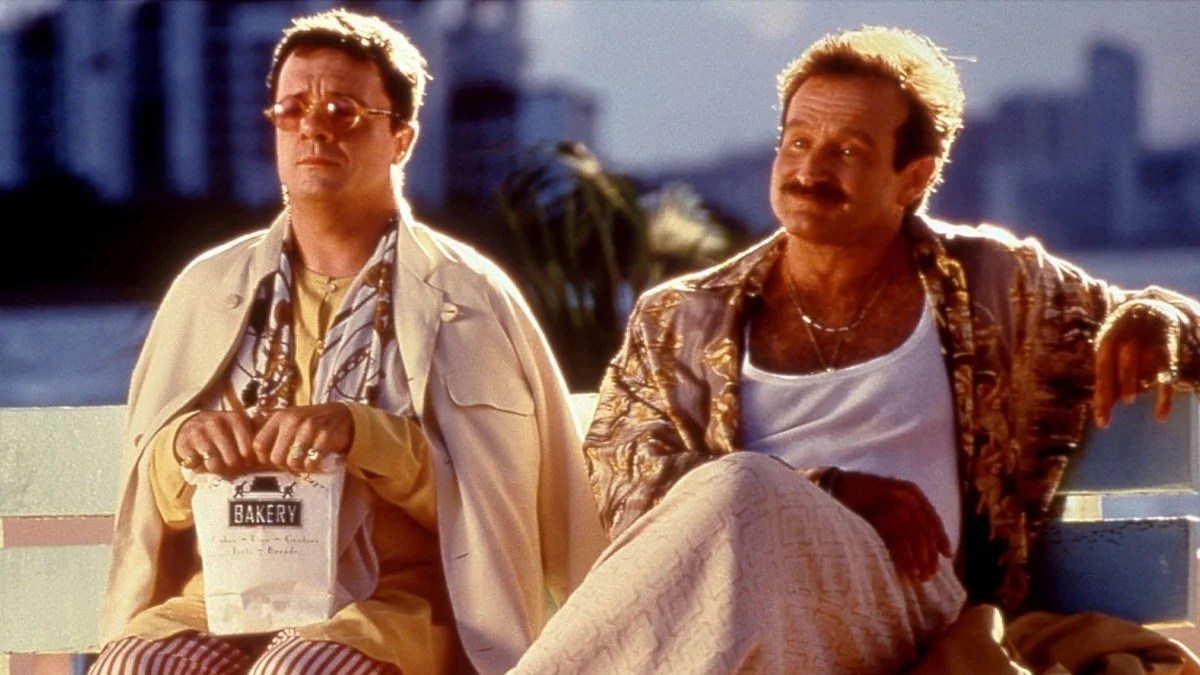 |
| Nathan Lane (left) and Robin Williams (right) in "The Birdcage". (Credit: MGM/UA) |
Nathan Lane will co-star with Matt Bomer, as well as Nathan Lee Graham (all three openly gay actors in real-life) and Linda Lavin on "Mid-Century Modern". The fourth character played by Linda Lavin, aside from being a Tony and Golden Globe award winner herself, she was also nominated for a number of Emmys for her TV role as Alice Hyatt on the TV sitcom "Alice" which ran for a total of nine seasons between 1976 and 1985. There is no denial that Linda Lavin is a sitcom veteran.
Ms. Lavin will step into the role of Sybil Schneiderman on "Mid-Century Modern" as the Nathan Lane character Bunny Schneiderman's mother who lives with her son in Palm Springs. On the sitcom "The Golden Girls", Estelle Getty played the comparable role of Sophia Petrillo. Linda Lavin brings a wealth of acting experience to the role, not only for her portrayal of Alice Hyatt on the long-running TV sitcom "Alice", but also having more recently starred in such short-lived TV sitcoms such as "9JKL" and "B Positive."
Matt Bomer will play the character perhaps most akin to Betty White's ditsy character Rose Nylund on "The Golden Girls" and he will be known as Jerry Frank on the new series. The character of Jerry is described as "pure of heart, hard of body and soft of head." The show notes also describe Jerry as a former Mormon who left his marriage in his 20s after his wife told him and the rest of their congregation that Jerry was gay. Bomer previously starred in the TV drama "White Collar" as a con-man and forger on that show.
In what appears to be the least fully-developed character on "Mid-Century Modern" is the character of Arthur Broussard, who will be played by actor Nathan Lee Graham. So far, there has been considerably less back-story released about the character of Arthur when "Mid-Century Modern" actually premiers, although the show's writers will be able to fill in those blanks for viewers. What we do know about Arthur is described in the show notes as "a dignified, elegant, longtime member of the fashion industry who believes that life will never quite match the grace and panache that would exist if only he were in charge".
That said, in an interview about the show with long-time entertainment journalist Michael Musto which was published in Queerty, Nathan Lee Graham answered some outstanding questions about the new show's characters and their comparability to the characters in the sitcom "The Golden Girls".
First, he confirmed that Season 1 will consist of 10 episodes (much like many streaming sitcoms have).
Beyond that, he told Mr. Musto:
"The show ['Mid-Century Modern'] is its own thing, but it's nice to be compared to something you truly love ['The Golden Girls']."
When asked who is the show's Dorothy Zbornack (Bea Arthur's character on "The Golden Girls"), Graham response was telling:
"Here's the thing. We’re all combinations of all of them, of different sorts. But I’d say that Arthur is mostly a Dorothy." He added: "...also, we all have those wonderful quips and sneers and deadpan looks [most similar to the character Dorothy Zbornack on "The Golden Girls"]."
He added:
"I love the little connections [to the characters in "The Golden Girls"]. As for Blanche, there's a little of her in all of us, but some other cast members are more Blanche than I."
That suggests while there will be similarities, it will not simply be a modern reboot of a loved, old show. It will be its own show with characteristics in each character from those loved in "The Golden Girls".
Life After "Will & Grace" on TV
The TV sitcom "Will & Grace" was one of the most successful television series with gay principal characters and aired between 1998 to 2006 (which returned for a single season in 2017). Max Mutchnick and David Kohan created "Will & Grace" which focused on the friendship between best friends Will Truman (Eric McCormack), a gay lawyer, and Grace Adler (Debra Messing), a straight interior designer. Alongside them were their friends Karen Walker (Megan Mullally), a demonically alcoholic socialite, and Jack McFarland (Sean Hayes), a gay neighbor and sometimes actor. Those four cast members were the core cast of "Will & Grace", which was the most successful television series with gay principal characters. "Will & Grace" ran for eight seasons, although as noted, the show was brought back on television with a ninth season which aired during 2017–2018.
In 2012, during an appearance on NBC's "Meet the Press," then Vice President Joe Biden said "I think 'Will and Grace' probably did more to educate the American public [about what gay individuals are actually like] than almost anything anybody's ever done so far."
In more recent years, we have enjoyed some ground-breaking TV sitcoms (many on paid streaming platforms) with openly gay characters, including the original Netflix series "Grace & Frankie" which was about two senior women whose husbands leave them (for men, specifically each other's husbands). That Marta Kauffman-created series co-starred the legendary Lily Tomlin (herself a lesbian) and Jane Fonda, along with their recently-out gay ex-husbands on the show played by Martin Sheen and Sam Waterson. Tomlin and Fonda are perhaps best remembered for their blockbuster eighties feminist comedy movie "Nine to Five". In "Grace & Frankie", the two actresses ended up creating comedic gold aimed squarely at an older, and decidedly gay-friendly audience.
But all good things must eventually end, and "Grace & Frankie" enjoyed an impressive seven season run in the modern media environment, becoming the longest-running original series on Netflix. Now, "Grace & Frankie" now enjoys a dedicated subchannel on free ad-supported streaming TV apps including on the Roku Channel and on Plex, where the un-edited show now streams continuously on a loop (and it's available for no subscription charge!).
Still, "Grace & Frankie" was about two older, heterosexual women living together (their ex-husbands were gay, and were recurring characters on the show, although those characters were more about setting the show's basic premise of older women learning to live life after their husbands leave them for each other's husband, rather than the show being specifically about the gay couple specifically.
That's why "Mid-Century Modern" reads as something of a gender-swapped interpretation of "The Golden Girls" with a slight twist in that the character of Sybill Schneiderman is also a mother like Estelle Getty's character on "The Golden Girls" known as "Sophia Petrillo" was, and the mother character on "Mid-Century Modern" will be played by Linda Lavin. But, aside from "Grace & Frankie", we haven't really had much on television which had both the older-age angle, along with a particular gay sensibility. Really, "The Golden Girls" set a modern gold standard which so far, has proven quite hard to replicate with such a legendary cast and consistently exquisite writing and producing.
Certainly the cast, and the creative and production talent behind "Mid-Century Modern" all suggests this show is likely to be successful. Officially, there is no word yet on when the show expects to be introduced.
In other words, the new show looks somewhat like a modern-day reboot of "The Golden Girls" featuring three gay men, along with one of the character's mother, all sharing a house together. "Mid-Century Modern" also reportedly will feature a "naked Gen Z housekeeper" although it's unclear how central to the storyline that will actually be. And while "The Golden Girls" was set in Miami, Florida, "Mid-Century Modern" will be set in Palm Springs, California, those differences are rather minor. Of course, Hulu is not restricted by the federal law which "prohibits obscene, indecent and profane content from being broadcast on the radio or TV" because streaming shows are not governed by the FCC, it is a genuine sitcom with legitimate names and talent behind it, so no one expects it to be filth.
Nevertheless, the similarities between the two shows ("The Golden Girls" and "Mid-Century Modern") are not hard to notice. For example, one of the characters happens to live with his mother, while two other roommates live with them in the same house. They are all slightly older (although some critics have noted that Matt Bomer is currently age 46, he will likely play a character who is likely age fifty, and it's worth remembering that actress Rue McClanahan was age 51 in 1986 when "The Golden Girls" first began (5 years older than Matt Bomer is in 2024).
"Mid-Century Modern" Production Nuts and Bolts
Kohan and Mutchnick formed company with a name combined from their two last names known as KoMut Entertainment, which helped make such TV shows as "Boston Common", "Will & Grace", "$#*! My Dad Says" and "Partners". In addition to several movies, Ryan Murphy created the FX cable TV drama series "Nip/Tuck", then produced a musical comedy-drama musical series known as "Glee" which ran on Fox for 6 seasons, followed by the anthology series "American Horror Story" which ran on FX for 12 seasons.
But now that the "Mid-Century Modern" series has the go-ahead, it means they just need scripts, then they can record the episodes.
The basic premise of the "Mid-Century Modern" series will be that it follows three best friends — gay gentlemen "of a certain age" — who, after an unexpected death, decide to spend their golden years living together in Palm Springs where the wealthiest one (played by Nathan Lane) lives with his mother (played by Linda Lavin). A less developed fourth character Arthur will be played by Nathan Lee Graham; the fourth character on "The Golden Girls" was Blanche Devereaux (played by Rue McClanahan) who was a sexy Southern belle. We'll wait for the writers to fill-in Arthur's backstory and what his character will be like, but remember: "Mid-Century Modern" will not be exactly like a "Golden Girls" reboot, so we may see certain behaviors exhibited by different characters.
"Mid-Century Modern" will run on the streaming platform Hulu, which is owned by Disney, although Hulu has struggled somewhat to gain a loyal following, lacking any "must-see" comedy sitcoms other than old reruns of old TV shows (including the original version of "The Golden Girls"). Streamers do seem to have considerably more leeway in terms of story lines which network TV has to edit out to avoid FCC charging them with obscenity. Streamers also don't necessarily need to stick to a particular amount of time for a given episode, although most do for consistency and for the benefit of their writers and actors. However, language need not be sanitized unnaturally. Ditto for occasional nudity, although it's not porn. The new series will be set in Palm Springs, California which is known for being home to a large LGBT population. The show already has a core cast, a director, writers, producers, etc. James Burrows is directing the pilot. Max Mutchnick, David Kohan, Burrows, Lane and Bomer will also exec produce. 20th Television is the studio. "Mid-Century Modern" is set to release sometime in 2025, and since it's on a streaming platform (Hulu), it's likely only going to have 10 episodes in its first season.
20th Television is the television production division of 20th Century Studios. It was known for a while as 20th Century Fox Television until it adopted the 20th Television name in 2020. The original 20th Television was the studio's television syndication division until it was folded into Disney-ABC Domestic Television in 2020. The creators and producers are well-established in Hollywood.
Related Story Links:
https://variety.com/2024/tv/columns/matt-bomer-nathan-lane-golden-girls-ryan-murphy-1236041246/
https://www.desertsun.com/story/life/entertainment/television/2024/06/19/mid-century-modern-hulu-show-palm-springs-nathan-lane-matt-bomer/74149021007/
https://screenrant.com/mid-century-modern-show-sitcom-matt-bomer-nathan-lane-ryan-murphy/
https://www.thestranger.com/slog/2022/01/18/65092818/why-do-gays-love-the-golden-girls
https://www.queerty.com/mid-century-modern-star-nathan-lee-graham-says-the-golden-girls-inspired-show-is-gay-nirvana-20241130
Author P.S., December 30, 2024: Deadline Hollywood first reported and it was confirmed by numerous reputable news outlets including Associated Press that actress Linda Lavin has died at age 87. Linda Lavin was said to have died in Los Angeles of complications from recently discovered lung cancer, her representative, Bill Veloric, told the Associated Press in an email. However, the coroner's report indicated she officially died of cardiopulmonary arrest with the underlying cause being lung cancer. She was working as recently as December 2024 promoting a new Netflix series in which she appears, "No Good Deed," and filming a forthcoming Hulu series, "Mid-Century Modern," according to Deadline, which first reported her death. TheWrap reported that the first season of the show had just 3 episodes left to shoot, which means that 70% of the first season was already done. Her castmates all commented on her passing; People magazine compiled their reactions to her death. Now, the writers will have to evolve the show given her passing. Her character will reportedly pass away in the series. While the "rule of four" remains a long-running sitcom key to success, "Mid-Century Modern" could theoretically pivot to focus on the remaining three cast members. If there is a season 2, and they want to continue with four main cast members, then a replacement such as one of the other character's mothers (or a sibling) could step in if the producers wish to stick with four main characters.
Author P.S., January 28, 2025: Former "Modern Family" co-star (and out gay actor himself) Jesse Tyler Ferguson has a podcast series which he calls "Dinner's On Me" in which he takes different celebrities out, and they talk over dinner or lunch (or breakfast, I guess). On January 28, 2025, Jesse Tyler Ferguson invited Nathan Lane to the restaurant known as Crustacean in Beverly Hills, California. In that conversation over dinner, he talked with Nathan Lane about his new Hulu series "Midcentury Modern" (which Jesse Tyler Ferguson will appear in an episode), and how the sitcom is kind of like an R-rated version of "The Golden Girls" (since it will run on Hulu and how that affords the producers to not censor themselves as they would have to on broadcast network television). Before the podcast episode begins, he acknowledges the passing of Linda Lavin who had died just weeks earlier on December 29, 2024 and he dedicates this particular episode to her. Visit the podcast episode at https://podcasts.apple.com/us/podcast/nathan-lane-on-doing-r-rated-golden-girls-in-new-hulu/id1683905652?i=1000684425864 or listen below.
Author P.S., February 18, 2025: Broadway World reports that series co-creator Max Mutchnick took to Instagram to share that all ten episodes of the show are set to drop on Hulu on March 28, 2025. Meanwhile, Matt Bomer wrote "That's a wrap on season one of Mid-Century Modern! This show was a dream come true for me in so many ways" alongside a photo of the cast and crew" adding: "I'm going to have to make a new bucket list! I can't wait for you all to see it. Midcentury Modern is coming to @Hulu soon!" Hulu has since released some graphic images, seen here.


Author P.S., March 12, 2025: The Late Show with Stephen Colbert featured Nathan Lane as a guest, and among the topics they discussed was "Mid-Century Modern" which can be seen below, or at https://youtu.be/Uqsrxnj80zw?si=XQTFTC6FJ01GYA0K. Have a look.
Author P.S., March 24, 2025: Finally, TV Guide magazine which has long been the country's de facto listing of television programming around the country, featured a cover with "Mid-Century Modern". See it below, or by visiting https://www.tvguidemagazine.com/archive/suboffer/2020s/2025/20250324_n1.jpg.html for more.

Author P.S., March 27, 2025: New York City's 92nd Street Y[MCA] often features unique performing and literary artists to large audiences in its Theresa L. Kaufmann Concert Hall. On March 27, 2025, the 92nd Street Y featured a screening preview of an episode of this new TV show, followed by a conversation with the stars and creative team behind Hulu's "Mid-Century Modern", specifically with creators Max Mutchnick and David Kohan as well as actors Nathan Lane, Matt Bomer, and Nathan Lee Graham. Ordinarily, such events are limited exclusively to ticket-holders. While the show's screening was not shared, the free ad-supported streaming TV platform known as Zeam now has a subchannel dedicated to 92nd Street Y content which is referred to as 92NY. It just so happens that the March 27, 2025 conversation with the creative team behind the Hulu sitcom "Mid-Century Modern" and three of the performers happens to available to anyone in the U.S. on the Zeam streaming app, as well as on its website (this is designated as Season 1 Episode 29) which can be watched at https://zeam.com/publishers/845/92ny#episode:1073795016. Check it out!
Author P.S., September 29, 2025: TV Line is reporting (see https://tvline.com/news/mid-century-modern-season-2-cancelled-hulu-statement-1235451766/ for the article) that series creator Max Mutchnick announced on Instagram that Hulu is cancelling "Mid-Century Modern" after just one season with the commentary: "Ten great episodes… Not enough," he wrote. "But we loved making every single one of them. We're gonna miss our very special show. Thanks to everyone who watched." TV Line also suggested that Pamela Adlon, who recurred in Season 1 as Bunny's sister Mindy, was expected to make more regular appearances in Season 2, filling a void left by Linda Lavin. The news comes as parent company Walt Disney Corp. is making some major changes, including raising the price of the Hulu service's ad-supported subscription tier from $9.99 to $11.99, a significant increase of about a 20%, along with concurrent plans to subsequently try to roll Hulu content into its core Disney+ service. Disney lacks a major FAST (free ad-supported streaming TV) platform where the sitcom might fare better as rivals such as Paramount have, but the Disney+ dynamic is a major risk for Disney as viewers who favored Hulu subscribed for more traditional television fare, not animated Disney films and cartoons which are a major draw for Disney+. Theoretically, another streaming platform could potentially pick-up "Mid-Century Modern" although the landscape for those platforms is currently undergoing major changes (a shakeout) at the moment, so it's unclear what appetite for a rival to pick the series might exist.