That song, which authors Gael Fashingbauer Cooper and Brian Bellmont who wrote the book "Whatever Happened to Pudding Pops?: The Lost Toys, Tastes, and Trends of the 70's and 80's" wrote in their entry entitled "Story Songs" (which as the authors note, are still going strong noting that as long as country music lives, the story song will never die)! Escape (The Piña Colada Song) was actually about cheating on your woman, with your woman (whoops). That classic track can be listened to below, or by visiting https://youtu.be/TazHNpt6OTo:
Central to The Piña Colada Song was a personal ad the singer responded to because he was getting bored with his girlfriend, so he responds to a personal ad he read in the newspaper, and to his surprise, the person who wrote the ad was his own girlfriend whom he hoped to cheat on. Irony? Perhaps. But the central role of personals will likely be with us for a long time to come, even if they are no longer printed in the back pages of the newspaper, but move online, or to the mobile environment.
Classified ads are a form of very brief advertising which was very common in newspapers and other periodicals, and more recently, it has migrated online (e.g. driven by free ads) and even to mobile applications, dealing with offers of or requests for jobs, houses, apartments, cars, personals, etc. The ads may be charged or distributed free of charge. Typically, classified ads in newspapers were very short as they were charged per letter, line or column. As the name suggests, classified ads are classified into different classes or categories.
The original U.S. newspaper ad was published in 1704 in the old Boston News-Letter. The ad was an announcement seeking a buyer for an Oyster Bay (on Long Island, New York) property. That ad reportedly marked the birth of newspaper classifieds in the United States.
Personals
One form of classified ads that has long been treated with suspicion are the personal ads (or personals). Indeed, because abbreviations have long ruled in classifieds (real estate ads, for example, have many acronyms, as do employment ads), learning the appropriate lingo meant the difference between understanding and being clueless about what the ads said.
For example, an ad for a used car might read: 2010 Blu (for blue color) Toyota Camry, <50K mi (under 50,000 miles on the vehicle), 4D (4 doors) HB (hatchback), 4CY (4 cylinder engine), 4WD (for a 4 wheel drive auto), ALUM/W (meaning the car has aluminum wheels), 4 new tires, $17K OBO ($17,000 or best offer).
That would read as:
2010 Blu Toyota Camry <50K mi 4D HB 4CY 4WD ALUM/W w 4 new tires $17K OBO eves 555-555-5555/email@email.com
That ad contains just 19 words, which is useful when you pay for an ad based on number of words and/or ad length.
Similarly, personals ads have their own unique lingo, usually something like this: 32 YO NM NS SWF (32 year old, never married, non-smoking single white female) ISO (in search of) SWM (single white male) HWP (height weight proportional) for a LTR (long term relationship). Likes: music, fine dining and BWAY (Broadway) shows. Call eves (evenings) at 555-555-5555 or email at email@email.com.
So the personal ad above would read:
32YO NM NS SWF ISO NS SWM HWP 4 LTR. Like music dining & BWAY. Contact eves 555-555-5555/email@email.com
All told, its exactly 19 words, and would be quite inexpensive (if the venue even charges for the ad) to run, and could potentially run for an entire week, possibly longer.
Of course, traditionally, personal ads have been viewed with a degree of skepticism, as there's really no screening involved so the risk is that a person will look absolutely nothing like their personal ad suggests. Terms like "average" (or AVG) are seen by skeptics as fat since most Americans are fat, and other terms like disease and drug free (DD FREE) used for ads seeking sex are perceived as something everyone writes, even if there's no basis in reality for the assertion.
Initially, classified ads dominated local newspapers (either dailies, or weekly alternative papers), but at the beginning of the new millennium, most of that activity shifted to online sites including craigslist.org or online dating or hookup sites (and their relevant mobile applications) including match.com, Tinder, OKCupid, or the site for married people seeking extramarital sex with others known as AshleyMadison or for gay male sex hookups grindr or scruff. As noted, increasingly, most also have apps which enable access from smartphones, although the allure of dedicated dating apps is seen as drawing the younger population more so than older people.
That said, in early 2018, the U.S. House of Representatives approved a bill known as FOSTA (allowing states and victims to Fight Online Sex Trafficking Act of 2017), which placed legal responsibility for sex-work interactions on the platform holders, rather than on individual users. It was a dramatic shift, since platform holders had, for years, been immune to legal responsibility for what their users do on their platforms, provided that they responded to inappropriate behavior effectively. The new law shifted the responsibility to companies like Craigslist, which concluded it was easier to simply abandon personals rather than face any legal problems or fines by puritanical lawmakers looking to stop supposed sex trafficking online.
Unlike companies including Facebook or Google, Craigslist has always been stubbornly simple, by design. It doesn't use advanced artificial intelligence (AI) or whatever to root out bad posts. Because of that, the site announced that it was taking down the popular Personals section entirely.
In its posting (see https://www.craigslist.org/about/FOSTA for the posting) about the legal development, Craigslist wrote:'
"Any tool or service can be misused. We can't take such risk without jeopardizing all our other services, so we are regretfully taking craigslist personals offline. Hopefully we can bring them back some day."
They closed by noting:
"To the millions of spouses, partners, and couples who met through craigslist, we wish you every happiness!"
It certainly doesn't mean personal ads are dead, rather just as they migrated from print to online, they are continuing to emerge elsewhere, and likely will continue doing so as long as people are seeking companionship, sex and more from other people.
Like the proverbial whack-a-mole arcade game, where one hits moles that pop up with a mallet only to have another pop up elsewhere. We also saw that in the early 1970's when theaters showing pornography would routinely open, be shut down, and then open up someplace else a few miles away.
The Future Is ... Personal Ads?
Still, the old-fashioned personal ad has some virtues, among them being that it enables people to be a bit more specific about what they're seeking in a partner. Women, in particular, find male-focused dating and sex hookup apps like grindr or scruff tend to overlook content other than photos, with the ability to swipe left on a listing to skip over it in seconds, hence it tends to be extremely superficial. By comparison, someone seeking something a bit more informative is out of luck.
That's why a lesbian developed what she calls a queer online dating community formed around an old-school format for hookups: old-school styled personal ads. The New York Times reported (see https://nyti.ms/2wNrMXW for the article) that the outcome of that is an Instagram dating community called Personals or Personals on Instagram (linked to an Instagram account) that developer Kelly Rakowski built for lesbians; bisexual, transgender, queer, intersex and asexual women; and gender-nonconforming and nonbinary people. (Basically, anyone who isn't a cisgender and/or straight man.) Personals is not for straight couples or cis men.
 The term cisgender (also referred to as simply cis) is still not universally understood, but it basically means that one's gender identity exclusively identifies with their sex assigned at birth, but has nothing to do with sexual orientation. Both straight and gay men are cisgender since both identify as men, even if they are gay and have sex with other men. Likewise, heterosexual women and lesbians are also both cisgender. Because the term cisgender is still relatively new, even many gays and lesbians respond to the term with confusion.
Terminology aside, the idea that old school classified personal ads delivered via Facebook's Instagram social media network (although its designed to work WITH Instagram, even if its not a requirement) still generally presumes the use of a smartphone to generate photos for postings (although one can instead use a regular computer at http://www.personalspersonals.us/ without a smartphone, and it also excludes most men other than those who were previously female. Then again, given that gay men already have the Chinese-owned app Grindr for gay male sex hookups or the American-owned Scruff, and straight men can rely on many others including match.com, Tinder, OKCupid or ashleymadison (the latter one being for married people to have affairs) for similar purposes, the female angle of Personals for women is indeed unique.
Still, the idea of enabling old-school personal ads in a more modern environment is akin to many other things that have since become commonplace. Think about online video streaming services including Netflix, Amazon Prime video, Hulu, Kanopy as well as iTunes and Google Play, while music also includes the two just noted, as well as Spotify and possibly others which have yet to emerge -- all of which enable both streaming of video content or music online. Previously, one relied on broadcast radio and television, and later cable TV and video rental shops including Blockbuster Video to deliver those things, and today they are available on-demand with a broadband internet connection.
Whether the new women's version of Personals is widely adopted depends upon building awareness. Building awareness will also enable it to build a user base, which is really the key to a successful dating and/or hookup platform.
Classified ads are a form of very brief advertising which was very common in newspapers and other periodicals, and more recently, it has migrated online (e.g. driven by free ads) and even to mobile applications, dealing with offers of or requests for jobs, houses, apartments, cars, personals, etc. The ads may be charged or distributed free of charge. Typically, classified ads in newspapers were very short as they were charged per letter, line or column. As the name suggests, classified ads are classified into different classes or categories.
The original U.S. newspaper ad was published in 1704 in the old Boston News-Letter. The ad was an announcement seeking a buyer for an Oyster Bay (on Long Island, New York) property. That ad reportedly marked the birth of newspaper classifieds in the United States.
Personals
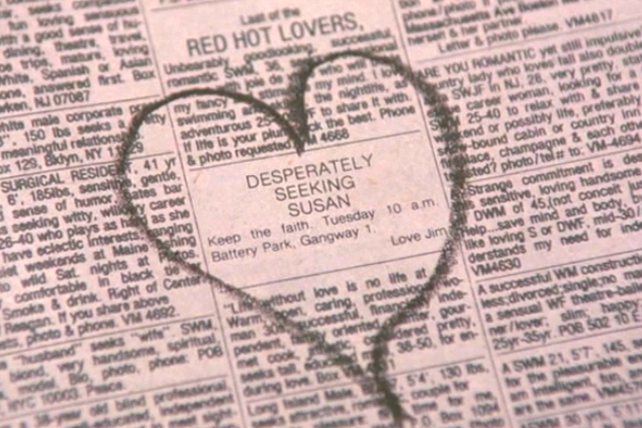 |
| The classified ad used in one of the few hit Madonna movies "Desperately Seeking Susan" from 1985 |
For example, an ad for a used car might read: 2010 Blu (for blue color) Toyota Camry, <50K mi (under 50,000 miles on the vehicle), 4D (4 doors) HB (hatchback), 4CY (4 cylinder engine), 4WD (for a 4 wheel drive auto), ALUM/W (meaning the car has aluminum wheels), 4 new tires, $17K OBO ($17,000 or best offer).
That would read as:
2010 Blu Toyota Camry <50K mi 4D HB 4CY 4WD ALUM/W w 4 new tires $17K OBO eves 555-555-5555/email@email.com
That ad contains just 19 words, which is useful when you pay for an ad based on number of words and/or ad length.
Similarly, personals ads have their own unique lingo, usually something like this: 32 YO NM NS SWF (32 year old, never married, non-smoking single white female) ISO (in search of) SWM (single white male) HWP (height weight proportional) for a LTR (long term relationship). Likes: music, fine dining and BWAY (Broadway) shows. Call eves (evenings) at 555-555-5555 or email at email@email.com.
So the personal ad above would read:
32YO NM NS SWF ISO NS SWM HWP 4 LTR. Like music dining & BWAY. Contact eves 555-555-5555/email@email.com
All told, its exactly 19 words, and would be quite inexpensive (if the venue even charges for the ad) to run, and could potentially run for an entire week, possibly longer.
Of course, traditionally, personal ads have been viewed with a degree of skepticism, as there's really no screening involved so the risk is that a person will look absolutely nothing like their personal ad suggests. Terms like "average" (or AVG) are seen by skeptics as fat since most Americans are fat, and other terms like disease and drug free (DD FREE) used for ads seeking sex are perceived as something everyone writes, even if there's no basis in reality for the assertion.
Initially, classified ads dominated local newspapers (either dailies, or weekly alternative papers), but at the beginning of the new millennium, most of that activity shifted to online sites including craigslist.org or online dating or hookup sites (and their relevant mobile applications) including match.com, Tinder, OKCupid, or the site for married people seeking extramarital sex with others known as AshleyMadison or for gay male sex hookups grindr or scruff. As noted, increasingly, most also have apps which enable access from smartphones, although the allure of dedicated dating apps is seen as drawing the younger population more so than older people.
That said, in early 2018, the U.S. House of Representatives approved a bill known as FOSTA (allowing states and victims to Fight Online Sex Trafficking Act of 2017), which placed legal responsibility for sex-work interactions on the platform holders, rather than on individual users. It was a dramatic shift, since platform holders had, for years, been immune to legal responsibility for what their users do on their platforms, provided that they responded to inappropriate behavior effectively. The new law shifted the responsibility to companies like Craigslist, which concluded it was easier to simply abandon personals rather than face any legal problems or fines by puritanical lawmakers looking to stop supposed sex trafficking online.
Unlike companies including Facebook or Google, Craigslist has always been stubbornly simple, by design. It doesn't use advanced artificial intelligence (AI) or whatever to root out bad posts. Because of that, the site announced that it was taking down the popular Personals section entirely.
In its posting (see https://www.craigslist.org/about/FOSTA for the posting) about the legal development, Craigslist wrote:'
"Any tool or service can be misused. We can't take such risk without jeopardizing all our other services, so we are regretfully taking craigslist personals offline. Hopefully we can bring them back some day."
They closed by noting:
"To the millions of spouses, partners, and couples who met through craigslist, we wish you every happiness!"
It certainly doesn't mean personal ads are dead, rather just as they migrated from print to online, they are continuing to emerge elsewhere, and likely will continue doing so as long as people are seeking companionship, sex and more from other people.
Like the proverbial whack-a-mole arcade game, where one hits moles that pop up with a mallet only to have another pop up elsewhere. We also saw that in the early 1970's when theaters showing pornography would routinely open, be shut down, and then open up someplace else a few miles away.
The Future Is ... Personal Ads?
Still, the old-fashioned personal ad has some virtues, among them being that it enables people to be a bit more specific about what they're seeking in a partner. Women, in particular, find male-focused dating and sex hookup apps like grindr or scruff tend to overlook content other than photos, with the ability to swipe left on a listing to skip over it in seconds, hence it tends to be extremely superficial. By comparison, someone seeking something a bit more informative is out of luck.
That's why a lesbian developed what she calls a queer online dating community formed around an old-school format for hookups: old-school styled personal ads. The New York Times reported (see https://nyti.ms/2wNrMXW for the article) that the outcome of that is an Instagram dating community called Personals or Personals on Instagram (linked to an Instagram account) that developer Kelly Rakowski built for lesbians; bisexual, transgender, queer, intersex and asexual women; and gender-nonconforming and nonbinary people. (Basically, anyone who isn't a cisgender and/or straight man.) Personals is not for straight couples or cis men.

Terminology aside, the idea that old school classified personal ads delivered via Facebook's Instagram social media network (although its designed to work WITH Instagram, even if its not a requirement) still generally presumes the use of a smartphone to generate photos for postings (although one can instead use a regular computer at http://www.personalspersonals.us/ without a smartphone, and it also excludes most men other than those who were previously female. Then again, given that gay men already have the Chinese-owned app Grindr for gay male sex hookups or the American-owned Scruff, and straight men can rely on many others including match.com, Tinder, OKCupid or ashleymadison (the latter one being for married people to have affairs) for similar purposes, the female angle of Personals for women is indeed unique.
Still, the idea of enabling old-school personal ads in a more modern environment is akin to many other things that have since become commonplace. Think about online video streaming services including Netflix, Amazon Prime video, Hulu, Kanopy as well as iTunes and Google Play, while music also includes the two just noted, as well as Spotify and possibly others which have yet to emerge -- all of which enable both streaming of video content or music online. Previously, one relied on broadcast radio and television, and later cable TV and video rental shops including Blockbuster Video to deliver those things, and today they are available on-demand with a broadband internet connection.
Whether the new women's version of Personals is widely adopted depends upon building awareness. Building awareness will also enable it to build a user base, which is really the key to a successful dating and/or hookup platform.


