In the era prior to the advent of music videos, the only genuine recordings (singles, albums) was often the recorded music itself (artist performances on film did not really exist, and tended to be exceptions). However, television performances on TV variety shows of the era were fairly close. Those recordings represent what we have for musical performances before music videos became routine.
Musical artists regularly guest starred on different variety programs of the day, including the legendary "The Ed Sullivan Show" which ran from 1948-71, "The Smothers Brothers Comedy Hour" which ran from 1967-69, "The Glen Campbell Goodtime Hour" which ran from 1969-72, "The Johnny Cash Show" which ran from 1969-71 on a different network, several incarnations of the "Sonny & Cher Show" which collectively ran from 1971-77, "Tony Orlando & Dawn Rainbow Hour" which ran from 1974-76, "The Captain and Tennille Show" which ran for one season between 1976-77, "The Jacksons" which also ran for one season between 1976-77, and of course, the legendary "Tonight Show" starring Johnny Carson which was really more than a late-night talk show.
The legendary "Carol Burnett Show" focus was really more on comedy, while musical performances were a secondary program idea.
While Glen Campbell, Johnny Cash, Tony Orlando & Dawn and The Jacksons all got their start in music, aside from Sonny & Cher, their variety shows were not primarily focused on music. They covered the full entertainment spectrum including TV, comedy and movies as well as music.
A relative late-comer to the music-themed variety show scene which ran from 1980-1982 on the NBC television network was "Barbara Mandrell & the Mandrell Sisters" which was co-produced by Sid and Marty Krofft who were better known for producing odd and vaguely sci-fi children's shows as "H.R. Pufnstuf" and "Land of the Lost". A brief fill-in known as "Best Time Ever with Neil Patrick Harris" ran for just a few months in 2015, but the genre proved far less suitable from a ratings perspective during an era where Americans enjoyed unprecedented access to hundreds of broadcast and cable TV stations (and this happened as even more choices became available with free ad-supported streaming TV ["FAST"] platforms such as PlutoTV had just emerged).
But in 1972, the U.S. TV business was still dominated by a few major broadcast networks (whose origins were in radio broadcast networks of the same names in the decades before), hence producer Burt Sugarman pitched a unique program which he called "Midnight Special" as a means for NBC to capitalize on a potential audience in a late-night time-slot. Mr. Sugarman said "Our aim was to reach for the 18-33 age bracket, the young married and daters who attend concerts and movies but don't watch much television".
NBC initially rejected the idea for Burt Sugarman's Midnight Special. None of the Big Three broadcast television networks had any recurring programming on after 1:00 am ET, and common practice by most network stations was to sign-off after the final program (some local affiliate stations ran old reruns after to entice viewers and advertisers alike). Despite a lack of competition in the late night time-slot, NBC was not interested…
But the NBC rejection led Mr. Sugarman to instead buy the air time for a premiere on his own as a brokered show, and he managed to persuade Chevrolet to become the show's first sponsor. The show premiered with ratings high enough for NBC to subsequently reconsider its original denial decision, and the network ultimately bought the program.
The Burt Sugarman's Midnight Special's original time slot was on Saturdays from 1:00–2:30 AM in the Eastern and Pacific time zones (Midnight to 1:30 AM Central and Mountain). Midnight Special ran from 1972–1981. By 1981, however, cable television had become commonplace in the U.S., and with it a number of cable-only television stations, including the original iteration of MTV: Music Television which was inaugurated in 1981 (although the cable network later shifted away from music in 1992 to cheap, low-quality "reality" show programming and has since abandoned music content completely).
One of the things which made Burt Sugarman's Midnight Special is it had musical performances from anyone who was anyone in the music industry between 1972-81. Those musical performances were recorded on film rather than video, meaning the quality of the performances has held up better than lower-quality video recordings of the same era have without digital remastering.
Alas, due to the many thorny issues with licensing of music, many of Midnight Special musical performances were presumed out of reach.
But on YouTube, Mr. Sugarman has released a surprising number of the original Midnight Special musical performances which are worth revisiting (if you saw them originally), or seeing for the first time now because they are a truly unique window into the music of that era.
I have created the following YouTube playlist for a sampling of some of the memorable music performances which aired on Burt Sugarman's Midnight Special. Have a look (and listen!), the list can be seen below, or by visiting https://www.blogger.com/blog/post/edit/7002826672729120464/8742372143663920791#
Once upon a time, when you bought a brand new automobile (including cars, trucks, vans, and minivans) from GM or Ford and likely also Chrysler (which was one of the successors to American Motors Corp. best known for its Jeep line of vehicles, preceded by Nash Motors, and as of 2024, was known as Stellantis N.V. which also includes Italy's Fiat, Germany's Opel, France's Citroën and some other auto brands), it was not unusual that if you spent enough money to buy an overpriced sound system from the car manufacturer, the company might also include a "starter" tape (at first they were 8-tracks, and then later, cassette tapes) to accompany their new vehicles in order to show-off their factory audio systems.
Not everyone who bought an auto-maker's sound system received the "starter" tapes, but some did. The starter tapes consisted of licensed popular music for intended for the auto dealers to be able to showcase their sound systems during test drives, and occasionally the auto dealers left the starter tapes in the cars for the new buyers.
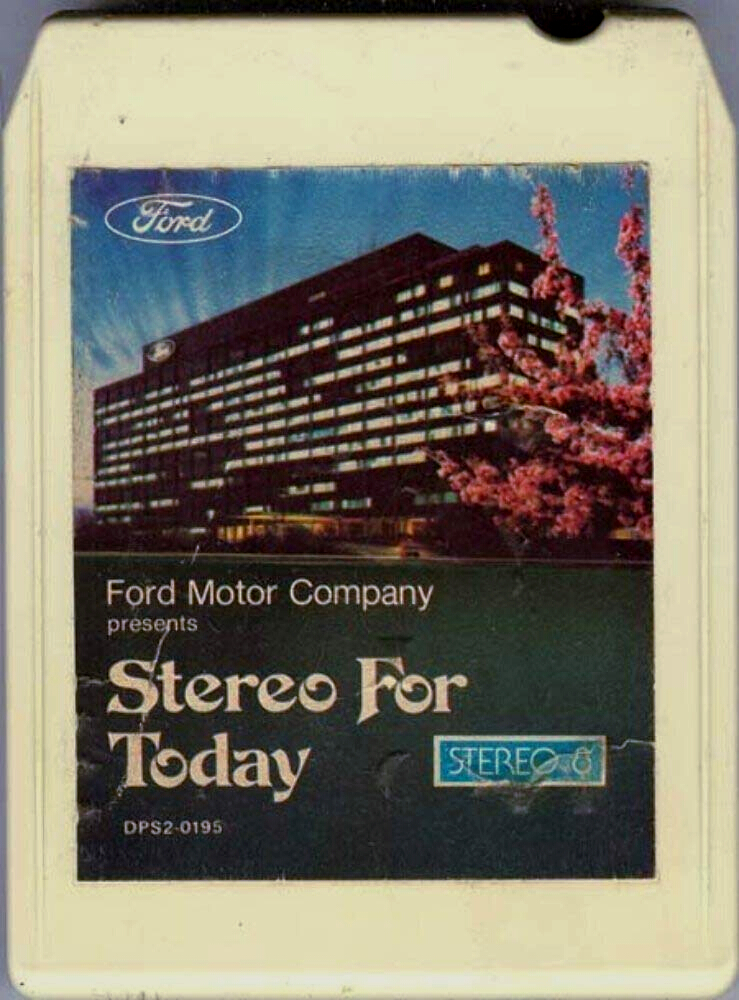
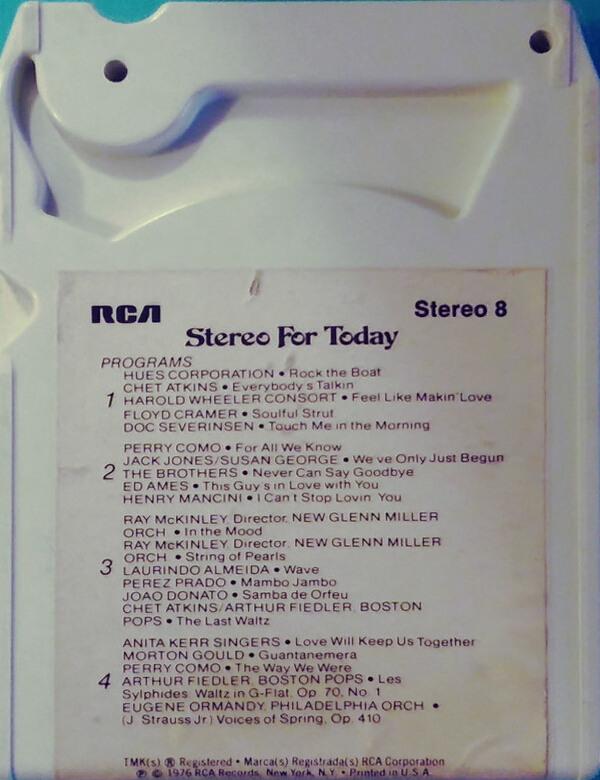
Today's post comes from the Internet Archive's audio archive, and it was a "starter" tape from Ford Motor Company in 1976. Apparently, the original tape was found when an heir was clearing out their grandmother's following her death in 1997. The grandmother's husband (the grandfather — had been a salesman for a local Ford, and later Chevrolet dealer until his death in the late 1980's. The Ford "starter" tape was an 8-track from 1976. The music on the tape was classic seventies music (including from stations which played oldies at the time) and a fair amount of this music might have been broadcast on local radio stations at the time.
The track listings are as follows:
A1Hues Corporation*–Rock The Boat A2Chet Atkins–Everybody's Talkin' A3Harold Wheeler Consort*–Feel Like Makin' Love A4Floyd Cramer–Soulful Strut A5Doc Severinsen–Touch Me In The Morning B1Perry Como–For All We Know B2Jack Jones / Susan George–We've Only Just Begun B3The Brothers–Never Can Say Goodbye B4Ed Ames–This Guy's in Love with You B5Henry Mancini–I Can't Stop Lovin' You C1Ray McKinley Director, New Glenn Miller Orch*–In The Mood C2Ray McKinley Director, New Glenn Miller Orch*–String Of Pearls C3Laurindo Almeida–Wave C4Perez Prado–Mambo Jambo C5Joao Donato*–Samba De Orfeu C6Chet Atkins / Arthur Fiedler, Boston Pops*–The Last Waltz D1Anita Kerr Singers*–Love Will Keep Us Together D2Morton Gould–Guantanemera D3Perry Como–The Way We Were D4Arthur Fiedler, Boston Pops*–Les Sylphides: Waltz In G-Flat, Op. 70, No. 1 D5Eugene Ormandy, Philadelphia Orch*–(J. Strauss Jr.) Voices Of Spring, Op. 410
I follow a guy on Twitter called DrPopCultureBGSU from Bowling Green, Ohio. He happens to share a TON of interesting pop culture images. The other day, he shared a picture of seventies pop music idol Andy Gibb (initially, I wrote Barry Gibb which was a mistake ... sorry!) wearing a muscle-shirt (even though he was a skinny kid who didn't really have very big muscles) with an image that struck me: Creem magazine.
Creem magazine was an alternative to Rolling Stone magazine or Billboard back in the seventies with a somewhat provocative title that evoked porn during a period when even THAT was still pretty taboo in mainstream culture, only the magazine's music coverage was unique in that it covered hard-rock, punk, alternative and new wave music which Rolling Stone and Billboard did not dare touch until those bands had already made it to the Billboard top 40. Creem began in 1969 (the year I was born), and continued publication until 1989. Its peak was arguably during the seventies.
I was listening to groups like Blondie, The Ramones, and Martha Davis and The Motels, or if I was feeling up to something a bit harder with more guitars, Iron Maiden or Def Leppard, while Rolling Stone was covering my parents' (Baby Boomer) music like Bob Dylan and James Taylor which we kids felt was more of a sedative.
Indeed, Creem was based in Detroit which most people believe gave it an editorial edge, hence its musical coverage was different from a New York or Los Angeles-based magazine likely was. As a result, Creem was favored by many people who didn't really like or consider reading mainstream musical coverage. Creem was edgy. The magazine covers were provocative, and article headlines were irreverant.
I also grew up on a street where the litter-bugs of the world literally threw Creem and other magazines out their car windows, so as kids we got to see Creem and read it. Initially, it looked like porn, but when I actually read it, I was impressed with Creem's musical coverage because it covered bands I actually listened to on college radio stations in the seventies into the early eighties. Creem spoke to me in a way that mainstream music magazines did not. Rolling Stone was for our parents, yet Creem was listening to what I listened to.
Apparently, Creem magazine is enjoying something of a resurgence thanks to a hit 2020 Netflix documentary called "CREEM: America's Only Rock 'n' Roll Magazine". The trailer for that film can be seen below, or at https://youtu.be/GUcCMNRTZpI:
Perhaps as noteworthy as the documentary, the old magazine now has a newly available digital archive where the old issues can be read again online (find it at https://archive.creem.com/ to read some of Creem's old coverage).
Which brings me to the Andy Gibb Creem picture. Sure, Andy Gibb was a teen idol at the time, but he was also an image of youth, and no mainstream music magazine was focused on youth at the time, they were all aging with Baby Boomers. They were becoming Yuppies.
The revival of Creem magazine was a passion product of JJ Kramer, the son of the magazine's founder, the late Barry Kramer. The original Creem magazine ceased publication in 1989. I was in college in the Boston area at the time. There were still other (now defunct) publications, such as Boston-based newspaper The Phoenix (and its radio station WFNX which sadly, today, is a lame country station which I would never listen to) which I read instead of Creem because it had news of bands which were coming to and/or playing around Boston at the time.
Capturing the messy upheaval of the '70s just as rock was re-inventing itself, the film explores Creem Magazine's humble beginnings in post-riot Detroit, follows its upward trajectory from underground paper to national powerhouse.
Then it bears witness to its imminent demise following the tragic and untimely deaths of its visionary publisher, Barry Kramer, and its most famous alum and genius clown prince, Lester Bangs, a year later.
Fifty years after publishing its first issue, "America's Only Rock 'n' Roll Magazine" remains a seditious spirit in music and culture.
Be sure to catch the Netflix documentary "CREEM: America's Only Rock 'n' Roll Magazine". It will be an interesting flashback to a time when music journalism was still in print.
In the 1990's, Gen X alternative rock artist Matthew Sweet gained fame for a song which peaked at #2 known as "Girlfriend". Matthew Sweet has some history of covering successful music ... successfully. Back in 1994, he was part of an ensemble of artists to record a track for a tribute album entitled "If I Were A Carpenter" (mentioned HERE). He sang the single "Let Me Be The One" on that successful album of covers — one which led to a temporary resurgence of Carpenters music at the time. While he continued recording original new music, his subsequent work never achieved quite the same amount of commercial success as "Girlfriend" did in 1995. Still, he had established a name for himself as a credible musician.
Then, about 15 years ago (around the year 2006), Matthew Sweet hooked up (in more ways than one) with Bangles singer/guitarist Susanna Hoffs. The Bangles achieved commercial success of their own back in the eighties with several chart-topping singles, including: "Walk Like An Egyptian" (#1, 1986), Manic Monday (#2, 1986), "Hazy Shade Of Winter" (#2, 1988) and "Eternal Flame" (#1, 1989) to name a few.
The couple (Matthew Sweet and Susanna Hoffs) shared professional (and personal) chemistry together at the time. The pair also achieved moderate commercial success as a musical duo on a Shout! Factory triage of albums. They had good vocal harmonies which worked pretty well together, combined with a quirky selection of music from successive decades starting with the sixties and culminating in the eighties. They nicknamed themselves as Sid n Susie (if you examine the album cover, note that "Sid n Susie" is carved in the tree of that image). However, when the couple's personal relationship ended, so did their professional collaboration.
Still, the duo's albums were named "Under The Covers" Volumes 1, 2, and 3 (the term "Covers" being an acknowledgement that the tracks are entirely covers of music originally recorded by other artists, and perhaps a tacit acknowledgement that the two were sleeping together at the time). Volume 1 was sixties music, volume 2 was seventies music and volume 3 was eighties music.
Today, I will focus on Matthew Sweet and Susanna Hoffs "Under The Covers" Volume 2 album from Sid n Susie. Their Volume #2 album has some pretty credible covers of the following songs originally released during the seventies. The links below are to the covers by Matthew Sweet and Susanna Hoffs (aka Sid n Susie):
Shout! Factory provided the following synopsis of the album, the text of which I have provided here:
"Matthew Sweet and Susanna Hoffs delighted rock and pop fans when they teamed up as Sid n Susie to record an album's worth of '60s classics called Under the Covers, Vol. 1. In the three years since, people have continued to ask us when Vol. 2 will come out and what it'll contain. Well, the wait is over: Under the Covers, Vol. 2 finds our heroes moving forward through rock's back pages to take on a other 'nother decade: the '70s.
From the power-pop like The Raspberries and Big Star to the soft-rock of Carly Simon and Bread, and from the classic-rock of John Lennon and Derek and the Dominos to the prog-rock of Yes, Sid n Susie offer a pretty thorough survey of the state of rock, just before the Sex Pistols."
One of the reasons I particularly like Sid n Susie's (Matthew Sweet and Susanna Hoffs) covers of their song selection is because the duo did not really attempt to creatively re-imagine or modernize the sound of the original songs they were covering, therefore the songs sound very familiar and are differentiated mainly by the unique vocals of the singers who are covering the songs. I find covers like those to be more worthy of my listening to them than when an artist changes a song. In fact, I rather enjoyed the covers!
I won't bother with a playlist of all of the tracks on "Under The Covers" Volume 2 here. But I have created a playlist of four of the songs I rather enjoyed listening to from the album, including "You're So Vain" (originally by Carly Simon, #1 1973), "I've Seen All Good People" (originally by Yes, #40 1971), "Hello It's Me" (originally by Todd Rundgren, #5 1973) and "Maggie May" (originally by Rod Stewart, #21 1971). Try listening to the original songs by the original artists, followed by the Sid n Susie covers back-to-back and then make your assessment!
In the mid-1970's, mobile phones weren't even invented yet. The few who actually had "car phones" at the time had special, analog radio phones, but those were so large they had to be hard-wired into the car and so power-hungry they needed access to the car’s alternator for power. Mobile service was controlled by the Ma Bell monopoly and the cost was prohibitively expensive. Plus, no one was carrying them around in their pockets. But, there was kind of an analog alternative: the Citizens Band Radio, better known by the acronym CB radio. Originally started in the 1940's and used by truckers, these inexpensive radios also made various forms of chatter over the public airwaves possible. CB radio communication wasn’t private, but neither were old party line telephones which had only been phased-out in the last parts of the country just a decade earlier.
Partly because of the 1973 oil crisis caused by the OPEC Oil Embargo of that year, and a new, nationwide 55 mph speed limit meant to save U.S. fuel consumption, the use of CB radios served a genuine need. Truckers found their CB’s to be very valuable in to help organize blockades and convoys in protest to the newly-imposed 55 mph speed limit. CB’s helped truck drivers locate service stations that actually had fuel available for sale, and also to warn other drivers of speed traps ahead. Remember: GPS was unavailable outside of the U.S. military at the time. But CB's were really enabled by the advent of solid state electronics technology which emerged and became commonplace starting in the early 1970's, which also enabled prices of the radios themselves to plummet and made them feasible as a mass market item which was not possible previously.
CB radios also enabled drivers to alert and/or seek assistance in case of an emergency. Ordinary people soon discovered that CB radios were also a great way to find where to get the cheapest gas, plus communicating and cooperating with other drivers on the road. They were adopted by the masses as part of a temporary (but big) fad during that period of time. In fact, they had become so popular that more than 2 million CB radio licenses were issued in 1974 alone. Eventually, there were so many idiots clogging the CB airwaves that more channels were needed, so 40 channel models were released instead of just 23.
Along with this technology came adoption of common user protocols, most notably the use of the relevant lingo or slang that existing CB radio users were already accustomed to using. Virtually all of this originated with truck drivers. "Breaker 19" was a way to introduce yourself to the people tuned into channel 19, whereas "That’s a 10-4" meant everything was OK and you understood, and "What's your 10-20?" meant someone was asking what your location on the road was. A much longer list of CB radio slang is currently available online at http://en.wikipedia.org/wiki/CB_slang or at http://www.cbgazette.com/slang.html if you're interested in reading more.
But as the CB radio technology became more widespread, soon the unique vernacular made it made its way into pop culture, including in broadcast radio, movies, television, news and even pop music.
Handles were what people called themselves over the airwaves without giving out their real names. Anonymity made it easier to evade police enforcement for telling others about police speed enforcement locations. Handles were akin to what screen names were in the era of internet chat rooms which are also now history. In fact, even former First Lady Betty Ford got into the act back in the day, admitting to using the handle "First Mama," while voice actor Mel Blanc (known as the voices in many original Warner Brothers and later, Hanna Barbera cartoons) talked over the airwaves using the guise of Bugs Bunny or Daffy Duck!
In 1975, the country music singer Merle Haggard released a song called "Movin' On" about truck-drivers who put CB radios and the lingo associated with CB's into wider use. Also in 1975, a novelty, one-hit-wonder song performed by C.W. McCall (a pseudonym of Bill Fries) became a #1 song on both the country and pop charts in the U.S. That song was "Convoy".
A brief snippet of the song "Convoy" can be listened to below, or at http://www.madmusic.com/song_details.aspx?SongID=2829 — because of byzantine copyright laws, only a short segment of the song is available. YouTube has a licensed copy of the original track from the Mike Douglas Show at https://youtu.be/j3VN54M1OXA if you want something more.
Convoys were essentially huge lines of trucks that traveled together down the nation's highways (often at higher than the posted speed limits), usually in protest to the new slower speed limits and police enforcement of those new speed limits (it's tough for police to pull over and ticket dozens of trucks travelling the same high speed simultaneously, hence they were pretty effective). They were most prevalent along the vast, empty stretches of highway so prevalent in Western states, "Convoy" was also the theme song for an eponymous movie released under the same name. That song was, in fact, written by C.W. McCall and Chip Davis who were a couple of ad guys from Omaha, Nebraska — their song "Convoy" was actually written initially for an ad campaign they were doing for a bread company at the time — but the single managed to land on and spent an impressive 6 weeks at number #1 on the Billboard country charts, an indication of just how big the CB fad had become.
On television, we saw the CB radio subculture showed up in the broadcast news, and in regular programming. For example, a television series "Movin' On" debuted in 1974 and ran to 1976 on NBC. The 1976 "Paul Lynde Halloween Special" on ABC (which, by the way, is currently available on Netflix, catch my blog about that TV special at http://hgm.sstrumello.com/2012/10/paul-lynde-1976-halloween-special.html for more) featured an entire segment about using a CB radio. In that segment, Paul Lynde was an 18-wheeled, white-pleathered rhinestone trucker. Tim Conway, best known for his comedic roles on the iconic "Carol Burnett Show" played his CB-buddy, while both of them fought over truckstop waitress Roz "Pinky Tuscadero" Kelly. She is remembered as someone who briefly starred as the Fonz's temporary girlfriend on the hit ABC sitcom "Happy Days" at the time.
By 1979, another NBC sitcom called "B.J. and the Bear" was introduced and that show ran until 1981. "B.J. and the Bear" was about a truck driver named B.J. (played by Greg Evigan) and his travelling companion, a monkey named "Bear" which featured routine CB radio usage, along with the then-popular CB lingo (catch a Retroist podcast about that particular TV series at https://archive.org/details/retroistbjandthebear for more info.). Again, CB radios were featured prominently in the show. Perhaps even bigger was the hit CBS TV show "The Dukes of Hazzard" (which also debuted 1979, running until 1985) and that also featured CB radios prominently throughout the series. CB radios were prominent throughout that show's six-season tenure as a means for the law-bending Duke brothers to avoid Sheriff Boss Hogg, Deputy Cletus Hogg, who was Boss Hogg's cousin and his dim-witted Deputy Sheriff Enos Strate. These days, due to the show's unapologetic romanticism of southern Confederacy (including a car named the General Lee) and the essential racism that drove it, that show is now rather limited in the rerun circuit, limited to a few cable stations such as CMT which has high viewership in the southern states that were home to the Confederacy.
On the big screen, there were several movies including "Smokey and the Bandit" (1977) which co-starred Burt Reynolds (he had already built a name for himself not for his acting but for being Cosmopolitan magazine's first-ever nude, male centerfold in 1972) and Sally Field plus Jackie Gleason and Jerry Reed. Of course, there was also the other big film "Convoy" (1978) which I previously noted. "Convoy" starred Kris Kristofferson — a Nashville singer-songwriter who was also, briefly, a pretty busy film star also willing to get semi-naked on screen, with one of his earlier starring roles in the award-winning film "Alice Doesn't Live Here Anymore" (1974) which was also the basis for a subsequent TV sitcom on CBS that starred Linda Lavin known simply as "Alice". Kristofferson would also subsequently co-star in the romantic drama reboot of the movie "A Star Is Born" (1976) with Barbra Streisand, for which he received a Golden Globe Award for Best Actor.
Like many things, the public fixation about CB Radios was definitely a genuine fad with its roots in utility. Today, the idea of CB radios seems more quaint than anything else, with mobile phones as portable, internet-connected devices being as ubiquitous and cheap as they are now. But, as noted, those simply weren’t around in those days, and car phones were prohibitively expensive and not at all portable, having to be hard-wired into the trunk of one's car and requiring a car alternator to power them, plus the service was controlled by the Ma Bell monopoly and prohibitively expensive, with metered, per-minute charges for every single call plus a hefty monthly service fee. That meant making only a few phone calls like that would exceed the prices people pay for 6 months of unlimited mobile service now, only without the internet.
I am of the opinion that even in 2020, mobile phones are still not exactly the pinnacle of modern technology (I wrote a post about how the iPhone did not kill the landline phone, the internet did, catch my post at http://hgm.sstrumello.com/2017/10/iphone-didnt-kill-landline-telephones.html for more), as they are first and foremost, one-on-one communications platforms (although internet connected apps may enable group platforms, such as Google Hangouts). The real benefit of a CB radio was that someone several miles ahead of you on a particular highway could warn you of upcoming traffic conditions, police activity, accidents, and most importantly: places where fuel was available, all of which you had yet to encounter on the road ahead. Hence, CB radios served a rather unique and useful purpose among truckers, plus CB's (aside from the initial purchase price) were free to use. CB radios had a range of about 3 to 20 miles, depending on the terrain. Originally there were only 23 channels, but subsequently expanded to about 40 stations. Police and firefighters used different radio bands that were not open to the public.
For whatever reason, the brief obsession with CB radios in the United States also likely stemmed from people’s desire to indulge their weird fantasies. This was in an era following the sexual revolution of the late 1960's and women's liberation. That's not to say that society wasn't still repressive, because it remained controlled by older people who were happy with the repressive 1950's. But CB radios provided anonymity for people to act as though they were someone else, plus is coincided with a public valorization of truckers and cops and people's desires of them (for women to be romantic with them, and for men to be like them).
"Instead of being relegated as a fleeting trend of the 1970s, perhaps CB radios were a precursor to the use of technology to create friendships and communicate anonymously with others." In other words, it was a precursor to modern social media, only it appeared 45 years ago!
The book "Whatever Became of Pudding Pops" which partially helped spawn this blog, wrote about the CB radio fad other the late 1970's and it was pretty interesting and entertaining reading. The chapter content was essentially as follows:
"Convoy"
Breaker one-nine, you got your ears on? Kids had no idea what CB chatter meant, but it sure was fun to pretend, holding a Romper Stomper to your mouth like it was a microphone and blabbing about "putting the hammer down" and "bears in the air."
We discovered the citizen's-band phenomenon when C.W. McCall recorded the 1976 hit "Convoy." You didn't have to understand the exotic new language (what in the world was a "cab-over Pete with a reefer on"?) to immediately fall in love with the romance of the eighteen-wheel lifestyle. "Convoy" told a classic tale of fighting authority, with the truckers crashing roadblocks and flaunting toll bridges.
Kids weren't the only ones who loved it. Adults started buying CBs for their Dodge Darts at such a frantic pace, the FCC doubled the number of available channels. Of course, no one knew any real CB lingo outside of the song lyrics, so real truckers had to suffer through listening to kids, desk jockeys, and housewives calling them "good buddy" until we grew sick of the craze and moved on to the next fad.
Today, the closest kids come to talking to truckers is when they pull an imaginary cord to try and get passing drivers to honk their horns. Still awesome? That's a big 10-4.
X-TINCTION RATING:
Gone for good.
REPLACED BY:
Cell phones made it much easier — if more dangerous — to communicate while driving, and personal radar detectors help modern drivers stay alert for smokeys.
FUN FACT:
C. W. McCall was the creation of a couple of ad guys from Omaha. Bill Fries and Chip Davis (who went on to launch electronic-music group Mannheim Steamroller) concocted the character and named him after McCall's magazine. The C. W. stood for country and western.
For today's post, it's necessary to properly set the scene: I'll begin in the 1970's. During early-to-late 1970's, disco dominated much of the U.S. popular music scene. At the time, Donna Summer and Gloria Gaynor were all at the top of the charts. In 1978, the "Saturday Night Fever" soundtrack was named Album of the Year. An event that has the been inaccurately referred to as the "death of disco" better known as the Disco Demolition which took place in Chicago's Comiskey Park, in reality, the story was always more nuanced than that. Steve Dahl, was then a 24-year-old DJ who was involved with that Disco Demolition event in Comiskey Park, was pissed off about being fired from a radio station that he worked for when it changed formats to all-disco. But even he disputes the importance of the Comiskey Park event, calling those who suggest that event was the official death of disco revisionist history. However, the Chicago Disco Demolition event was also understood to be a not-so-subtle attack against disco's earliest adopters: blacks, Latinos and gays, and each group faced fairly widespread discrimination anyway.
Disco Demolition at Chicago's Comiskey Park Marked a Time of Transition
The Comiskey Park event wasn't the death of disco so much as it was a marker of a period of musical transition.
Think about it: around 1977 when "Saturday Night Fever" finally hit the box office, a group of Baby Boomers were in their mid-to-late twenties, and they still wanted to go out and party. They patronized dance clubs and disco music was one of their favorite genres. But they'd already been doing that for a good number of years, and Hollywood was late to the game when "Saturday Night Fever" was even released. By the end of the decade, going out all night, boozing it up at discos and looking for one-night-stands/hookups was already starting to fall out of favor. Many Boomers were simply getting older, and they now they had families to support. It was hardly a coordinated, nationwide effort to destroy a musical genre. By 1979, disco and funk were starting to fade. At the same time, the Baby Boomers who just a few years earlier were key were also becoming less important to record sales. Their era of dominating popular music was reaching its natural end.
As noted, a shift in musical tastes was happening. Consider the Grammy Award winners in the years before (during) and after. It was never all-disco, before or after. For example, in 1977, Debbie Boone won two Grammys as Best New Artist of the Year, and for Song of the Year for the sappy song "You Light Up My Life". She was joined by Barbra Streisand for the "Theme From A Star Is Born (Evergreen)" that year. Neither artist resembled disco (although Streisand's record label would later push her into disco with several collaborations with Barry Gibb including "Guilty", "What Kind of Fool", the Gibb-written solo "Woman in Love", and another duette with disco diva Donna Summer "No More Tears". Ms. Streisand has gone on the record saying that none of those tracks are ones she is particularly fond of and she rarely performs them in concert, although they were all big [money-making] chart-toppers for her at the time). Beyond those, The Eagles' "Hotel California" won Record of the Year in 1977, while Fleetwood Mac's "Rumours" took home the Grammy for 1977 Album of the Year. The following year, Billy Joel won the Grammy for Record of the Year, and he also won several more next year, too. Some, although certainly not all, of these winners could arguably fall into the musical genre now known as Yacht Rock.
What is Yacht Rock?
If you are unfamiliar with the term, the term "Yacht Rock" is a type of soft rock that supposedly emanated from Southern California between 1976 and 1984. In the late 1970's and early 1980's, musical artists like Kenny Loggins, Michael McDonald, the Doobie Brothers, Steely Dan, Toto, Hall and Oates, and dozens of others regularly popped up on each other's records, creating a golden era of smooth-music collaboration.
On June 26, 2005, an internet phenomenon was born. In 12 short but memorable episodes — first via the the short-film series Channel 101 and then online — JD Ryznar, Hunter Stair, Dave Lyons, Lane Farnham and their friends redefined an era and coined a term for the sultry croonings of McDonald, Fagen, et al.: "Yacht Rock." http://www.yachtrock.com/ -- now known as the Beyond Yacht Rock podcast.
As "Hollywood" Steve might say, these guys docked a fleet of remarkable hits. This is the story of Yacht Rock, told from stem to stern — a reimagining of a bygone soft-rock renaissance, courtesy of hipsters with fake mustaches, impeccable record collections and a love of smoothness. Long may it sail.
The term Yacht Rock was coined to suggest a kind of smooth, mellow "soft rock" music that early yuppies likely enjoyed while sipping champagne and snorting cocaine on their yachts at the time. They have several criteria used for a song classified as such, although the label is more tongue-in-cheek than reality, but it was also a term for a genre which existed but was largely undefined, yet was still taking over the radio airwaves at the time. In my mind (and has been acknowledged by many others, including those guys), perhaps no one is a better representative of that musical genre than Christopher Cross.
Christopher Cross Swept the 1980 Grammy Awards
Christopher Cross in 2014
In 1978, a musician, singer/songwriter from San Antonio, Texas landed a solo contract with Warner Bros. Records. (These days, he calls the funky Texas capital city Austin home). A self-described "Army brat", Cross is the son of a U.S. Army pediatrician stationed at Walter Reed Army Hospital in Washington, DC in the mid-1950's, acting as physician for President Dwight Eisenhower's grandchildren.
The young Mr. Cross managed to land a record with Warner Brothers in 1978. In 1979, Christopher Cross (whose birth name was Christopher Charles Geppert) released his first, self-named solo album. The following year, Cross was nominated for six awards and he walked away with a stunning five (5) Grammy Awards, including each of the "Big Four" awards: album, record and song of the year, plus best new artist. He was the first person (and so far, ever) to win so many awards in a single evening.
Despite his quest during the 1970's to be signed with a major record label, Christopher Cross began with rather modest ambitions. He hoped his first album would sell 50,000 copies, enough for Warner Bros. to let him make a second album.
"I was hoping, maybe three albums down the stream, I could get something on the radio," Cross said. "So, when all that Grammy stuff happened, it took everybody by surprise."
Catching a Wave
Christopher Cross says that he caught a wave of change in pop music at the perfect time. Lightning struck again for him the following year, in 1981. Cross' bittersweet theme song for the hit movie "Arthur" reached No 1. "Arthur's Theme (Best That You Can Do)" (from the movie "Arthur" which starred the late British actor Dudley Moore and Liza Minnelli) also won an Oscar and a Golden Globe that year. Cross deserved all of the awards, too.
Although not by design, Christopher Cross arguably embodied (and pioneered) a musical genre now popularly referred to as Yacht Rock, and he and his music was decidedly not disco. But it was very popular and was a very refreshing change from the types of music that dominated the airwaves just a few years earlier, so people bought it -- lots of it. But, not surprisingly, it didn't last forever. It seldom does.
As The Advocate (see HERE) wrote about him (I should acknowledge that Christopher Cross is definitely not gay, but his music attracted a very widespread audience, including many gays and lesbians), he thought he had good odds of winning one Grammy.
He said: "I'd been told that I had a good shot at winning best new artist," Cross said. "Harry Belafonte and Herb Alpert presented that award to me. That was surreal. I went back to my seat, feeling content for the evening, ready to watch the show. And then, bang."
Cross won four more Grammys that night, including song of the year and album of the year.
"It was an out-of-body experience," he said. "We never imagined beating Barbra Streisand and Frank Sinatra and all these big artists."
"It just may have been the worst thing that could have happened to Cross. If he had just won one or two awards, few would have paid much notice. If he'd won best new artist, he would have beaten critics' faves Pretenders, but critics were used to having their favorites lose in that category. Elvis Costello had lost to A Taste of Honey two years earlier. John Prine and Eagles lost to America in 1972. Elton John lost to Carpenters in 1970.
But Cross' undoing won everything. His eponymous debut album beat Pink Floyd's The Wall and Barbra Streisand's Guilty for album of the year. His serene ballad "Sailing" beat Frank Sinatra's "Theme from New York New York" in three categories -- record and song of the year and best arrangement accompanying vocalist(s).
The sweep practically invited people to say, "Oh, he's not that good." Instead of bringing people to his side, the sweep turned many people off. Cross was a talented pop artist -- not a groundbreaking artist, but a skilled hit-maker, the kind who might have had a solid, five-year run of hits.
The Grammy sweep may have actually shortened his [music] career. "Arthur's Theme (Best That You Can Do," which he co-wrote with Burt Bacharach, Carole Bayer Sager and Peter Allen, topped the Hot 100 eight months after the Grammy sweep. It won an Oscar and brought Cross three more Grammy nominations (but no wins). Cross had two more top 20 hits, "All Right" and "Think of Laura," from his sophomore album, Another Page. But even a reunion with Bacharach and Sager to co-write the song "A Chance for Heaven," the swimming theme from the 1984 Summer Olympics in L.A., didn't reverse his flagging momentum. He hasn't appeared on the Hot 100 since 1985.
Remember Christopher Cross? In the early 1980's, his brand of silky-soft rock sailed up the charts. His songs were unavoidable on FM radio (as a side note: that soft-rock genre was commonly played in dentists' offices, and I vividly recall hearing it under the influence of nitrous oxide) -- and then as quickly as he burst on the scene, he seemed to vanish from it.
CBS Sunday Morning also let him share a funny story about an interaction he had with a TSA agent.
"I was going through TSA -- this has been a year, or maybe two years ago," Cross recalled. "And a woman took my boarding pass. And she said, 'Oh, Christopher Cross, there used to be a singer named that! He passed away! But he was a great singer.'
In the end, and with the benefit of hindsight, there's nothing Christopher Cross would do differently. He's continued to release music since 1980, and while none have swept the Grammy's since then, he still believes he's been very lucky.
Christopher Cross credits a lot of his incredible success to timing.
"There were many great artists back then who didn’t get a chance to be heard," he said. "I worked hard and I was talented, but I also was lucky. People were ready for some pop music. It was a perfect storm."
He also seems very humble, and not bitter he did not enjoy decades more commercial success in music. Now at age 68, he is content. As noted, today he lives in the eclectic capital city of Texas, Austin. Just as the Austin Independent Business Alliance adopted the slogan "Keep Austin Weird" to promote small businesses in Austin, Mr. Cross has no regrets about how his career has gone. Instead, he seems grateful he's had the opportunity. If that perspective doesn't deserve to enjoy sailing on a yacht, perhaps nothing does!
You don't have to be a fan of Elton John to know his music; even the most pop culture-oblivious person knows songs including "Bennie and the Jets," "I'm Still Standing", "Crocodile Rock" and of course, "Rocket Man". That's why the biopic movie "Rocketman" which opens this week is so anticipated.
Of course, Elton John is the public half of a genuine creative duo, with the other half being his longtime lyricist Bernie Taupin (actor Jamie Bell plays Bernie Taupin in the movie). The duo collaborated on more than thirty albums, even if the Rocketman was arguably the public persona. A great deal is riding on the film "Rocketman's" success.
As the New York Times observed (see its review at https://nyti.ms/2EfoGj5 for details): "Multiple movie studios passed on the opportunity to make "Rocketman," which is an R-rated musical biopic about music legend Elton John. They said it was too gay. Too expensive. Too reliant on an unproven star.
But one film company, the down-on-its-luck Paramount Pictures, saw the audacious project as a chance to prove something to both Hollywood and Wall Street — namely that, to borrow a reference from Sir Elton, it's still standing.
Now comes the moment of truth."
The New York Times adds that "Rocketman" arrives in theaters on May 31, 2019 as perhaps the most ambitious movie of Hollywood's summer season, a four-month period that typically accounts for 40% of annual ticket sales and relies overwhelmingly on franchises. "Rocketman" stars Taron Egerton and the movie cost an estimated $120 million to make and market worldwide. "Rocketman" trails glitter — a million Swarovski crystals adorn the costumes and eyewear — and even depicts gay sex, a first for a major movie studio.
Taron Egerton, 29, stars as Elton John and is perhaps best known for his role in the "Kingsman" action comedies, but he did all of his own singing, reinterpreting classics like "The Bitch Is Back." There is also intricate choreography (one stylized scene finds an entire London neighborhood dancing in formation) and an orgy musical number set to "Bennie and the Jets." Aside from Egerton playing the Rocketman himself and Bell playing Bernie Taupin, actor Richard Madden plays Elton John's one-time manager and lover.
It was very well-documented that virtually all gay imagery was downplayed in "Bohemian Rhapsody," (catch my review for that movie HERE) sometimes to the dismay of many people eager for Hollywood to prove it is less timid about the topic of homosexuality. Homophobes baselessly assert that exclusion of all reference to Freddie Mercury's sexual orientation was the main reason the film succeeded.
In reality, his sexual orientation was irrelevant. The timing was right for "Bohemian Rhapsody" and the same thing can be said for "Rocketman". The band Queen still resonated with a significant audience (making it relevant to Baby Boomers, Gen Xers and even some younger audiences who have heard of these artists on the radio and on popular TV shows like "Glee"), and more than a few of whom are still old enough to remember when they were still topping the Billboard charts. "Bohemian Rhapsody" became last year's blockbuster Queen biopic, which was nominated for the Academy Award for Best Picture last year among others, and actually won four Oscars. But the gay part in that movie was largely unaddressed.
Freddie Mercury was undeniably gay; in fact, he died from AIDS in 1991 which he'd contracted from unprotected male-on-male sex. But Freddie Mercury was not a solo act like Elton John was; he was merely the front-man for a band. Much of the downplaying of Mercury's sexuality was simply attributed to the existing Queen band members' desire to focus on a story more about the band as a whole, rather than being exclusively about the band's flamboyant front-man.
But unlike Freddie Mercury, Elton John (who is also gay) is still very much alive today and he is also one of "Rocketman's" executive producers, therefore he has been very influential in this movie's story, casting and direction among other things. That said, although a few fear that any depiction of same-sex relationships in "Rocketman" could potentially limit interest in more conservative parts of the U.S., most believe those concerns are vastly overblown, even though the contemporary romantic comedy "Love, Simon" did struggle more than rival films to reach theatrical coverage parts of the country in 2018 because it ventured a kiss between teenage boys.
But Elton John told The Mirror "I'm proud Rocketman is the first major studio film with a gay love sex scene in it. He says the scene was a very, very important part of his personal life. He added "I was a virgin until then [age 23]. I was desperate to be loved and desperate to have a tactile relationship," adding that if they were going to tell his story in the film that it had "to be honest."
He also added "If I'd left it out, I'd have felt I was cheating people. I'm so glad it's in there because I am a gay man and I didn't want to airbrush it under the carpet. If they don't like it, I understand, but it's part of who I am."
However, because the target audience for most movies skews heavily twenty-somethings anyway, many of whom have little issue with LGBT people and ask what the big deal is, it's likely a bit over-simplistic to suggest "Rocketman" won't find audiences even in red-state America. Elton John is not closeted. And national theater chains aren't as afraid of showing such movies as independent theaters once were, and the latter have largely fallen by the wayside in favor of chains. Financially, outside the U.S., "Rocketman" is expected to generate enormous ticket sales in countries like the UK and most of the English-speaking world as well as Western Europe, even though the film will likely not even make it past Chinese censors without severe sanitization, something that executive producer Elton John is likely to deem a nonstarter.
It's worth reminding people that "Bohemian Rhapsody" actually had the seal of approval from all of the surviving members of Queen. Although that film switched producers and lead actors several times before its ultimate release, in the end, the Queen band members all approved. Actor Rami Malek was ultimately selected as the actor, and he is credited with helping to make that film a success.
"Rocketman" has a similar blessing from Elton John. The movie "Rocketman" is also directed by Dexter Fletcher, who also took over the reigns for "Bohemian Rhapsody" once Bryan Singer left. The story for "Rocketman" — developed by the rocket man himself — but very much like "Bohemian Rhapsody" has gone through a number of directors (Michael Gracey) and lead actors (including both Justin Timberlake and Tom Hardy) since it was first announced in 2012.
John and Taupin at the 27th Annual Elton John Aids Foundation Academy Awards viewing party, West Hollywood. Photograph: Michael Kovac/Getty Images for EJAF
Beyond Elton John's sex life, however, perhaps the biggest focus is his downfall into substance abuse, and his recovery from that. Indeed, the movie opens and closes with Elton John speaking from rehab. His subsequent re-emergence as a successful artist is really the central story of "Rocketman". That element is arguably a by-the-numbers biopic focus, although many other biopics feature a tragic downfall without a benefit of recovery and resurrection, which is a somewhat unique perspective for "Rocketman". That recovery and resurrection is what Elton John himself wishes to focus on for "Rocketman".
However, the biggest question is whether the formula used for "Bohemian Rhapsody" by choosing a relatively less-known actor to lead and use of the same director will lead to similar success for "Rocketman"? Paramount certainly hopes so, and the friendship developed between Elton John and actor Taron Egerton who will play him in the movie suggests that "Rocketman" could see similar commercial success (even if the critical reception by the Academy is highly dependent on what else is running in cinemas during the year).
The trailer, as well as two brief interviews with actor appears below, or by visiting https://bit.ly/2Xg5Orq.
Much has been written about the Swedish super group called ABBA. After all, the group has more than proven its endurance to a global audience.
The group's iconic logo was/is also a registered trademark
Songwriters and musicians Björn Ulaeus and Benny Andersson first met in 1966, and in 1969, the seeds of the soon-to-be Swedish supergroup were planted when Björn met his fiancée, Agnetha Fältskog, and Benny met his fiancée, Anni-Frid (known as Frida) Lyngstad, and the group formed in Stockholm in 1972. Ulvaeus and Andersson knew how to write contagious pop hits, but Fältskog's and Lyngstad's beautiful harmonies were integral to the global chart-topping ABBA sound. The group's name is an acronym from the first letter in each of their names. In 1974, ABBA was the contestant for Sweden in the Eurovision Song Contest, the pan-European music festival. Sweden (and ABBA) took home the prize as the winner of the Eurovision contest that year with their performance of the song "Waterloo".
Although relatively unknown outside of Scandinavia at the time, ABBA used the Eurovision song contest as a launching pad to become a global pop music sensation. While Sweden has long been one of the world's largest cultural exporters (books, music, film, television programming, etc.), likely because in Swedish public schools, the population is taught English in as a core subject (along with Swedish and mathematics) staring in grade school between the ages 7 and 9, depending on the school attended. Indeed, most Scandinavians are praised for having both fluency in English and language competency in addition to their own native tongues, hence Swedes successfully export to the broader English-speaking world.
Anyway, in 1974, in spite of competing against the likes of Olivia Newton-John who represented the UK in Eurovision that year (unfortunately, she sang a boring song entitled "Long Live Love" that year, and her outfit was similarly conservative), ABBA grabbed the top prize. A video of the group's winning performance in the 1974 Eurovision contest can be seen below, or by visiting HERE.
Not only was the ABBA song "Waterloo" understood across Europe, but the band also wore what were considered pretty daring costumes that year, too. Their costumes were certainly eye-catching: shiny, satin, all-in-one outfits and even shinier knee-length hot-boots. The costumes were explained largely as a way to exploit a Swedish tax law. As long as their outfits were so outrageous that they could not be worn on the street, the band could claim the cost of the outfits were tax-deductible.
ABBA band member Björn Ulvaeus recalled: "In my honest opinion, we looked like nuts in those years. Nobody can have been as badly dressed on stage as we were." Björn added: "We figured with our clothes, people would remember us even if we finished ninth." Frida noted: "We chose clothes we felt comfortable in. My favorite was a body stocking with a little dress cut diagonally. I thought I was elegant and sexy in it."
But the costumes fit right into the disco era which was just emerging around the world at the time, and people remembered the band who wore such colorful (if garish) outfits. It didn't hurt that their music was universal, and the harmonies of the women's voices in the group sounded great. They took their knack for memorable (if ugly) costumes, along with catchy lyrics and danceable pop melodies and became a global superstar group whose success is in many ways, unparalleled. All told, ABBA released eight studio albums over their original 10 years together. Perhaps their most iconic single was their 1976 hit "Dancing Queen" which can be listened to below, or by visiting https://youtu.be/xFrGuyw1V8s?si=HojD4RRc6NKTZylr.
"Dancing Queen" was ABBA's biggest hit in the United States (going to number one), and it also topped the charts in Australia, the Netherlands, Belgium, Ireland, Mexico, New Zealand, Norway, South Africa, Spain, Sweden, the UK, Germany and Zimbabwe. "Dancing Queen" also reached the top five in many other countries.
At their commercial zenith in the late 1970's, ABBA were reputedly second only to Volvo in their contribution to Sweden's exports. While figures vary, industry watchers agree that ABBA has sold at least 200 million albums and singles worldwide (some unconfirmed estimates put the figure closer to 400 million, behind only The Beatles but ahead of Led Zeppelin, Pink Floyd and Queen), and certainly comparable to the Rolling Stones. Collectively, estimates are that ABBA has earned more than $2 billion in album and singles sales during its career.
The 1974 Eurovision-winning band was actually made up of two couples — Agnetha Fältskog and Björn Ulvaeus, and Benny Andersson and Anni-Frid (Frida) Lyngstad. Both couples would later split as the band became most successful, and ABBA broke up as a group in 1982. ABBA was always bigger in terms of studio recordings, but decidedly less so when it came to touring and live performances. Despite some disagreements among the quartet, the four largely remained in touch and they seem fairly united in decision-making that has perpetuated their fame and fortune. The original ABBA team have proven themselves VERY adept at continuing the nurture their money-machine by carefully licensing their songs to bands and singers who have kept their songs continually playing (and selling).
For example, in 1992, they wisely licensed several of their songs to the UK pop duo Erasure (Vince Clarke and Andy Bell) which released an EP of four of ABBA's best-known hits. That EP revived ABBA's songs for a generation of young adults who grew up listening to the original ABBA songs on the radio, and was also Erasure's first and only #1 on the UK Singles Chart for the single "Take A Chance on Me", plus it got significant airplay in the U.S., Canada, Australia and New Zealand.
ABBA later licensed its songs to live theater productions of the show "Mama Mia" which opened in London and remained a best-seller there, replicating that successful run in New York, Toronto, Sydney and elsewhere. The stage version's worldwide gross from 49 productions exceeded $2 billion in 2015, having been seen by 500 million people. The 14-year Broadway run alone grossed more than $600 million, according to the trade group Broadway League.
In 2014, the ABBA band-members released a video they called "The Last Video" which can be seen below, or by visiting https://youtu.be/8L6T6Yj5u4k which is indicative of the continued creative work from the group members.
ABBA's West-End/Broadway success with "Mama Mia", in-turn, lead to the Hollywood movie version of "Mama Mia" that starred Meryl Streep. The "Mamma Mia" movie version of the all-ABBA musical was released by Universal and earned the band another $600 million at the box office, while the sequel (whose story was panned) still quietly earned another $280 million during just its first four weeks without even factoring in DVD and streaming sales, licensing to cable television, etc. ABBA also released (or was it really a re-release of their biggest hits?) "ABBA Gold: Greatest Hits", which has been called one of the most influential compilation albums ever released, and sparked a strong revival of ABBA's music that has endured well into the 21st century.
In 2018, one guest-star of "Mama Mia 2", herself a seventies pop icon Cher, released a whole new album of ABBA covers following her appearance in the sequel movie. She announced one of the singles "Gimme! Gimme! Gimme!" via her active Twitter account.
Cher told the press (see HERE): "I've always liked ABBA and saw the original Mamma Mia musical on Broadway three times. After filming "Mamma Mia! 2: Here We Go Again", I was reminded again of what great and timeless songs they wrote and started thinking 'why not do an album of their music?' The songs were harder to sing than I imagined but I'm so happy with how the music came out. I'm really excited for people to hear it. It's a perfect time."
Meanwhile, back in Stockholm, Sweden, the ABBA The Museum is a Swedish interactive exhibition about the pop band ABBA that opened in Stockholm, Sweden in May 2013. ABBA's collected works are showcased in a contemporary, interactive setting at Djurgården, Stockholm.
ABBA also announced that the Swedish foursome had recorded several brand new songs during 2018, its first in 35 years, which will be released in early 2019. The original band members are all now in their seventies, so studio recordings are one thing, but the group has said they have no intention of doing any live performances. But there ARE plans for a TV special, and a separate digital project to recreate the four members performing as what they're branding their 'ABBAtars' using the experience gained from the ABBA Museum to further their commercial success on a global basis.
Just how much longer ABBA can perpetuate its "Money, Money, Money" tree remains to be seen. But they've proven themselves perhaps the most successful at merchandising their music in a way that few other bands have yet to replicate -- it doesn't just happen, it takes a degree of talent, intellect and work -- but perhaps could pave the way for future artists in the 21st century?
The internet has a collection of the truly obscure! The website Plaid Stallions, with a heavy focus on toys from the 1970's, featured a 1978 newspaper flyer for K-Mart including ads for toys of that era. However, because its the holiday season, memories of shopping at cheesy, American discount stores like K-Mart is also no doubt something for which many people are familiar.
Notably, the Internet Archive is assembling a massive digital collection of miscellaneous things, some quite impressive, such as the emulator library of video games and home video game consoles as well as handheld devices which I've addressed in prior posts, including one about Speak & Spell and other items, for example. There are also video clips from different sources, and a large audio collection. Due to copyright issues, audio can be more challenging, but sometimes the work is already done by others, in this case the once-giant discount retailer K-Mart Corporation.
Shoppers of K-Mart may recall the retailer's in-store audio background music which was periodically interrupted by K-Mart product commercials which were usually introduced with the phrase "Attention K-Mart Shoppers". A collection entitled "Attention K-Mart Shoppers" is one such collection. It even contains special audio advertisements announcing the addition of a new K-Mart pharmacy from 1974 where shoppers could fill their prescriptions.
As the archivist Mark Davis admits, this is a somewhat strange collection. In the late 1980's and early 1990's, he worked for K-Mart behind the service desk and the store played specific pre-recorded cassettes issued by corporate (before that, they were reel-to-reel tapes sent to each store location every month to keep the background music fresh). This was background music, or perhaps you could call it elevator music. Some have some recordings of musicians including the likes of Neil Diamond, for example. He saved the tapes from the trash during this period, and its built from his extensive, if odd collection, although others have since supplemented his recordings. One of these recordings date back to December 1974, evidenced by the continuous loop of Christmas music that was featured. Separately, there was also a Muzak Christmas music tape from another collection which was quite similar, except its missing the regular K-mart ads throughout. Another 1973 recording featured the company's advertising jingle used at the time about K-Mart being "your savings store". There are even some in the collection that came from vinyl recordings when the company still went by the name S.S. Kresge which date back to the 1960's. An October 1989 recording is possibly the type most people who shopped at K-Mart back in the day will remember. Most recordings are differentiated mainly by the introductory spot introducing the retailer to shoppers, as if the big red "K" and the aqua-blue "mart" wasn't enough of a tip for them to know exactly where they were.
Until around 1992, the cassettes were rotated monthly. Then, they were replaced weekly. Finally sometime around 1993, satellite programming was introduced which eliminated the need for these tapes altogether. The older tapes contain canned elevator music with instrumental renditions of songs. Then, the songs became completely mainstream around 1991. All of them have advertisements every few songs.
He notes that the monthly tapes were very, very, worn and rippled at the time they were converted to MP3 files. He says that's because they ran for 14 hours a day, 7 days a week on auto-reverse. If you do the math, assuming that each tape is 30 minutes per side, that's over 800 passes over a tape head each month.
Still, for anyone interested in this peculiar collection of background music that played in K-Mart stores during that era, this collection might be worth listening to.
This week (on November 2, 2018), the Queen biopic movie known as "Bohemian Rhapsody" opens in the U.S. Its a story about the entire band, but the group's lead singer and front man known by the name of Freddie Mercury is really the central focus.
Freddie Mercury was actually born Farrokh Bulsara. He was of Parsi descent, which is an ethnic group in India whose origins are in what is considered present-day Iran, but the group fled religious persecution in Persia (Iran), and ended up in what is now India. His given name is Parsian in origin. However, while some of his formative years were spent in India, Freddie Mercury was actually born in what was then the British protectorate of Zanzibar in present-day Tanzania on the African continent. He lived there (as well as in India) before he, his parents, and his younger sister moved to England when he was just a teenager.
Queen was a global superstar rock group back in the 1970's into the early 1980's. The group dominated the charts across the English-speaking world, with a string of radio hits including the signature song for which this biopic film was named, as well as "We are the Champions", "Another One Bites the Dust", "Somebody to Love", "Crazy Little Thing Called Love" and others which continue to be played even today. Front man Freddie Mercury was the lead singer, and also a songwriter for the band. He was known to have a four-octave vocal range. The band Queen also enjoyed a brief U.S. resurgence in popularity following the release of the 1992 movie "Wayne's World", which featured "Bohemian Rhapsody" in its soundtrack.
The "Bohemian Rhapsody" biopic covers the years between the formation of Queen by Freddie Mercury, Brian May, Roger Taylor and John Deacon, telling the story of the beginnings of the band, up until their show-stealing performance at the LiveAid concert in 1985. The audio for the classic rock song (originally released in 1975) "Bohemian Rhapsody" can be listened to below, or by visiting (fast-forward one track) https://archive.org/details/lp_greatest-hits_queen-david-bowie/disc1/01.02.+Bohemian+Rhapsody.mp3:
Actor Rami Malek was ultimately cast as lead singer Freddie Mercury, and most reviews suggest that he is a key reason the film worked as well as it did.
Actor Rami Malek, who portrays Freddie Mercury in the movie "Bohemian Rhapsody" about the rock band Queen and its lead singer Freddie Mercury on October 1, 2018. Photo credit: Paul Marotta/Getty Images for 20th Century Fox
Originally, Freddie Mercury was to be played by Sacha Baron Cohen, better known for his comedic characters Borat, Ali G, and Brüno. But in 2013, Sacha Baron Cohen dropped out of the role due to creative differences with the remaining members of Queen. Cohen reportedly wanted a more realistic, R-rated look at the band and Freddie Mercury's life, while the band preferred going for a PG tone. They reportedly parted on good terms, but the band felt that Cohen's presence would have been distracting. In 2017, Rami Malek was chosen to play Freddie Mercury. Malek is actually an American actor of Egyptian and Greek descent, but his physical characteristics made him a very credible choice for the role, and he has been credited with an excellent depiction of the singer, too. There is slightly less media focus on the other band members, although given that several of them were involved in the casting and production, we can presume most of the original Queen band-members were satisfied with their portrayals.
There has been plenty of criticism about the "Bohemian Rhapsody" including the filmmakers' largely ignoring front man Freddie Mercury's sexuality. In fact, the criticism for attempting to "straight-wash" the rock icon has merit: "Bohemian Rhapsody" devotes considerable screen time to Freddie Mercury's "romance" with Mary Austin — the woman he wrote the hit song "Love of My Life" about — before it even starts to address his many relationships with men near the halfway part of the movie.
As the Guardian's Steve Rose touched upon the subject (see the review at https://www.theguardian.com/film/2018/oct/23/bohemian-rhapsody-review-freddie-mercury-biopic-bites-the-dust for details), stating: "Unforgivably, Bohemian Rhapsody casts Mercury's wilderness years as a symptom of his gayness. We see the solo Mercury in Munich, drug-addled, shorn of his real friends and exploited by his new ones, who are mostly leather-clad, party-happy men. It reduces Mercury's homosexuality to a tutting "he's got in with the wrong crowd".
"It is a painfully by-the-numbers biopic, squeezing the narrative into a 'Walk Hard' box while struggling with the simple fact that (at least as portrayed in this film) Freddie Mercury's life wasn't all that cinematic. Just because someone makes great art and has an interesting personality doesn't mean they merit a narrative feature film based on their life and exploits. When Mercury and his bandmates are working their magic, the movie will rock you. But when its going through the biopic motions, you won't be having a good time."
Mendelsohn has a point; there are parts of the movie that are excellent (such as the performances), but there are also parts that are not as good. Whether that means the film is homophobic is probably a mischaracterization. There is no doubt Mercury was definitely a product of his era: during the '70's and '80's, in spite of being post-Stonewall, true equality in terms of socially acceptable behavior and sexual orientation were still quite different than today. The late pianist and showman Liberace (catch my post on his biopic at http://hgm.sstrumello.com/2013/05/steven-soderberghs-newest-movie-depicts.html for more) was a product of the earlier part of that era, whereas Freddie Mercury was a product of the latter part of that era. Gay and bisexual performers, and assuredly transgendered performers (although few of the latter had very big careers in show business) were expected to, and generally did, live closeted lives.
In fact, Mercury is known to have had sex with both men and women, and the filmmakers were doing a biopic of the band Queen over a 15-year period, not a detailed expose of the front man's personal sex life. In fact, Freddie Mercury was once described by a former lover -- the German soft-porn star Barbara Valentin -- as "mostly gay." And, of course, he died at age 45 in 1991 from complications of AIDS, which although impacted heterosexuals too, was particularly rampant among men who had sex with other men. In fact, Mercury himself publicly confirmed that he'd contracted the disease just one day before his death. According to his longtime male partner Jim Hutton, Freddie Mercury was diagnosed with AIDS in late April 1987. During his lifetime, he was also known to have frequented many gay leather bars in across Europe, New York, Chicago, Los Angeles, San Francisco and elsewhere, so he wasn't truly closeted. The handlebar mustache he wore during the LiveAid concert (which would be one of his last public performances) was also a popular look among the gay leathermen crowd in the 1980's.
However, upon his death, Freddie Mercury did end up leaving his London home to Mary Austin in his will (which was a 28-room Georgian mansion set in a quarter-acre manicured garden surrounded by a high brick wall), which she'd picked out for him, rather than to his male partner Jim Hutton, saying to Ms. Austin, "You would have been my wife, and it would have been yours anyway."
Other criticisms include, of all things, the teeth that actor Rami Malek wore in the film. NPR's Glen Weldon had this to say (see the NPR review at https://n.pr/2zkjrv6) about those:
"They're ... something, those teeth. They distend Malek's upper lip, just as the real ones did Freddie Mercury's — more, actually; it's not so much an overbite as an überbite."
Aside from criticism of teeth (of all things), NPR acknowledged:
"Early worries that the film might elide Mercury's queerness prove unfounded, mostly. Sort of. True, his long romance with Mary Austin (Lucy Boynton) is presented as the one relationship in his life that he clings to — but that feels less like a desire to whitewash his gayness and more like an attempt to address the very believable possibility that a gay man of his time and place, with his upbringing, would find himself reluctant to abandon a relationship that represented a life he'd been brought up to expect for himself."
Regardless of his sexual orientation being bi, gay or straight, the real question becomes whether this biopic is a realistic view which can be squeezed into a two hour movie. The movie aims to chronicle the 15-year period between their formation as a band and their famous performance at LiveAid at Wembley Stadium in 1985. That LiveAid performance can be seen below, or by visiting https://archive.org/details/20180315020139:
As noted, actor Rami Malek's performance as Freddie Mercury has been praised almost universally. Mr. Malek played Elliot Alderson for a second season in USA Network's psychological drama "Mr. Robot". The actor, whose credits also include "Short Term 12" and "The Master", won an Emmy for Outstanding Lead Actor in a Drama in 2016. In spite of those credits, he remains relatively unknown, which may be his biggest advantage. When audiences don't know what to expect from an actor, they won't be disappointed. But as noted, the reviews of his performance as Freddie Mercury have been overwhelmingly positive.
In any event, there is certainly enough in the new movie "Bohemian Rhapsody" to merit watching it. Whether its a perfect depiction will ultimately be up to the viewers. I suspect the feelings will be mixed, but Mr. Malek's performance will ensure the actor will get consideration for future movie and television roles. The "Bohemian Rhapsody" movie preview is available below, or by visiting https://www.foxmovies.com/movies/bohemian-rhapsody or https://youtu.be/mP0VHJYFOAU:
Writer, speaker, brother, son, friend, spouse, advocate for people with autoimmune (type 1) diabetes, thinker, dreamer. Reading and writing is becoming a lost art, but we can learn a lot from reading the medical and scientific literature before drawing conclusions. The press publishes abbreviated facts to fit into limited space, I don't mince words or omit facts.